USB-C Cable Power Ratings: 60W, 100W, 240W EPR Explained
Cable wattage is the most printed and least understood spec in accessories. This guide decodes what 60W, 100W and 240W EPR actually encode, how e-marker chips decide the limits, and how to build a cable assortment that matches real devices instead of real confusion.
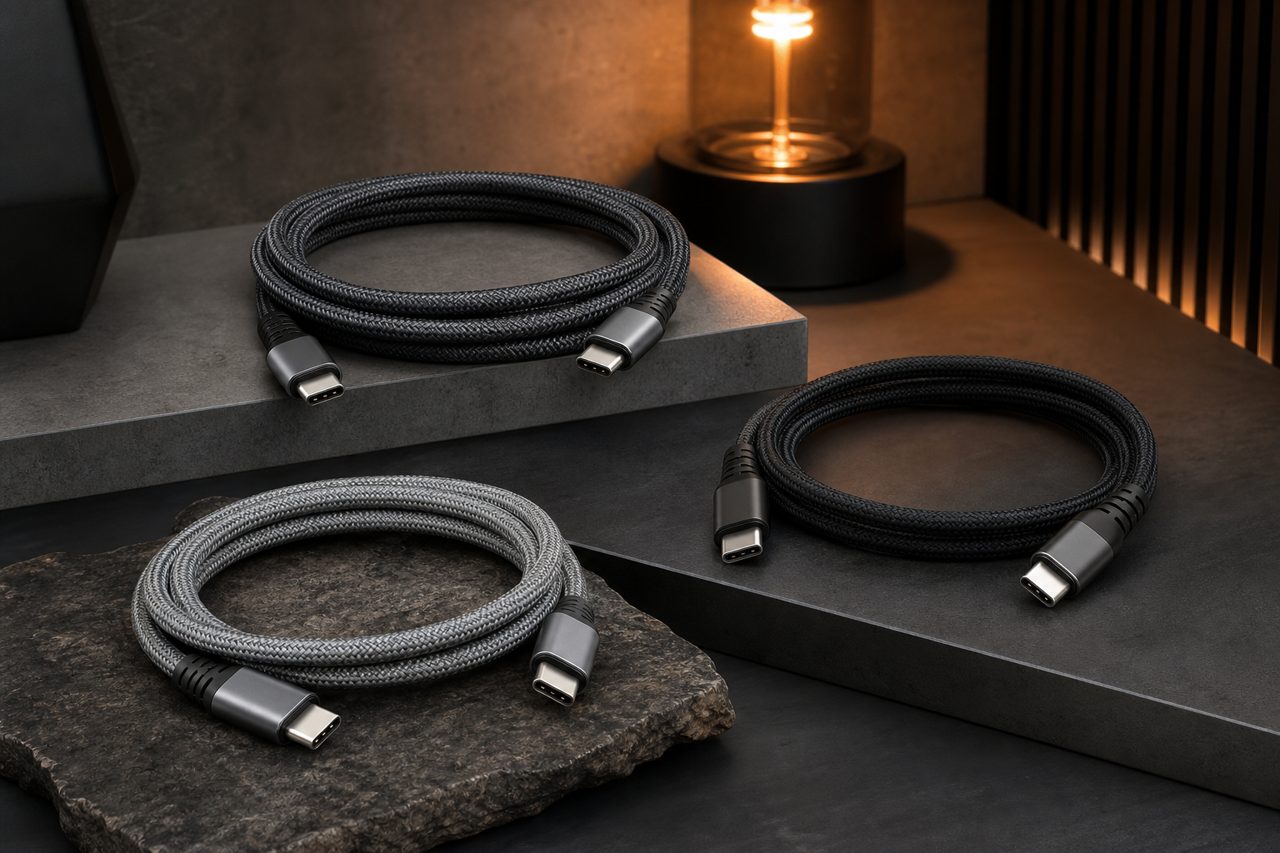
Cables used to be the free add-in; the EU common charger rules changed that permanently. Since December 28, 2024, phones, tablets, earbuds, cameras and a growing list of device classes must charge over USB-C in the EU (European Commission), which moved the cable from landfill promo to product in its own right. Customers now buy cables deliberately, and they arrive holding one number: the wattage. For a reseller, being able to explain that number honestly is both a conversion tool and a returns shield, because most "my charger is broken" tickets are actually cable tickets.
The rating system in plain terms
A USB-C cable's power rating reduces to two physical facts: how much current its conductors can carry, and how the USB Power Delivery specification stages voltage. Under the standard PD range, fixed voltage steps run from 5V up to 20V. Multiply 20V by the current the cable can carry and you get the wattage classes customers see:
- 3-amp cables, 60W. The baseline. Twenty volts times three amps gives 60W, and no e-marker chip is required at this current.
- 5-amp cables, 100W. Twenty volts times five amps gives 100W, and USB-C requires an e-marker chip in cables that operate above 3A, so the device can read what the cable supports before pushing that current.
- EPR cables, 240W. The Extended Power Range, introduced with USB PD 3.1, adds voltage steps at 28V, 36V and 48V. Forty-eight volts times five amps gives the 240W ceiling, and EPR needs an e-marker that explicitly supports it.
That is the entire decoding table. The wattage printed on the box is a derived number; the amperage is the physical constraint, and the e-marker is the chip that makes the constraint legible to the device. Everything else on a cable listing, data speed, jacket material, length, is a separate axis that has nothing to do with these three classes.
Physics explains why the 3A and 5A tiers exist at all. Current through a conductor produces heat proportional to resistance, so a 5-amp cable needs thicker copper, better crimps and connectors that can sink the extra warmth. That is also why an under-spec 5A cable occasionally becomes a safety story rather than only a slow-charging story: the rating is a thermal statement as much as an electrical one. When a supplier quotes ratings, the question behind the question is which conductor gauge and which connector stamping sit under the print.
The protocol layer behind this ladder is covered in detail in our PD 3.1 vs PD 3.0 comparison.
What each rating actually charges
Ratings map onto devices more cleanly than customers expect, which is what makes the classes useful for assortment planning:
| Rating | Electrical basis | E-marker required | Typical devices | Stocking role |
|---|---|---|---|---|
| 60W | 20V x 3A | No | Phones, tablets, small laptops, earbud cases | Volume base; widest audience |
| 100W | 20V x 5A | Yes | Most laptops, docks, multi-device desks | Profit tier; the desk standard |
| 240W EPR | up to 48V x 5A | Yes, EPR-capable | High-power laptops, large displays, workstations | Specialist SKU; growing with EPR devices |
Two implications follow. First, a 100W cable is backward-compatible down the ladder: it charges a phone exactly as well as a 60W cable, so it is never the wrong upgrade to sell. Second, the 240W class only engages when both ends support EPR; a 240W cable attached to a 100W laptop is simply a well-built 100W cable, which is worth stating in listings because customers read it as overkill rather than headroom.
Charging watts and data speed are different axes
The most common listing confusion in the category mixes power and data ratings. A cable can carry 100W and still run USB 2.0 data speeds, because power conductors and data pairs are separate. Conversely, a full-featured cable might carry 40Gb/s and 5A, which is why it costs several times a basic charge cable. Neither is a scam; they are different products answering different jobs.
Listings should therefore state the two axes separately and never let one imply the other. A practical format: "100W charging, USB 2.0 data" or "240W EPR, 40Gb/s". Buyers who write vague copy like "supports fast everything" inherit the confusion returns of a category they did not have to enter.
Reading a cable listing honestly
The same skepticism applies when evaluating a supplier's catalog. The checks that matter:
- Current rating stated, not just wattage. A "100W" claim without a 5A statement hides whether an e-marker is inside.
- E-marker verification on a reader. The chip's programmed capabilities can be read directly; the printed label cannot always be trusted (see the e-marker guide).
- Length versus rating. Longer cables are harder to build to the same rating; the physics of gauge and voltage drop is covered in the cable length article.
- Jacket and strain relief. These decide how long the rating survives handling; the trade-offs are compared in the jacket comparison.
Building the assortment
For most sellers the assortment logic is a pyramid:
- Volume base: 60W, 3A, 1-2 meters. The phone-and-tablet majority. Compete on jacket quality and warranty, not price alone.
- Profit tier: 100W, 5A, 1-2 meters. The laptop-and-dock desk audience. This is where braided jackets and better connectors pay for themselves.
- Specialist tier: 240W EPR, short to medium lengths. A small but underserved audience that currently pays a premium; worth one strong SKU before expanding.
Lengths beyond three meters deserve caution at any rating, for the reasons the length article explains. And any listing that pairs cables with GaN chargers should match the classes deliberately: a 240W charger shipped with a 60W cable is a refund request in a gift box.
Sourcing and quality control
Cable ratings survive or die in QC. The bench checks are inexpensive: read the e-marker on a reader and compare against the spec sheet, run the rated current on an electronic load and watch the temperature at both connectors, and cycle the plug into a port to check retention. All three fit in an afternoon per SKU.
Sourcing follows the standard ladder: stock models ship from a single piece for dropshipping validation, logo and packaging customization starts at 500 pieces per SKU, and full OEM with custom jacket colors and connector plating starts at 1,000 pieces per SKU, with structural changes from 3,000. Sampling runs 5-7 days for light customization and 7-12 days for full OEM. The current cable lineup sits on the cables and hubs category page, and the customization path is on the OEM/ODM page.
FAQ
Does a 60W cable limit a 100W charger?
Yes. A 3-amp cable caps the charging chain at about 60W under USB PD regardless of charger or laptop capability. The charger negotiates down to the weakest link, which is why the cable is the first thing to check when a fast charger underperforms.
Does a 100W laptop need a 240W EPR cable?
No. A 5A cable rated 100W covers every device at or below 100W, including most laptops. The 240W EPR class serves the small group of devices that draw more, and it engages only when both device and cable support EPR.
Why do 100W and 240W cables cost more?
Heavier conductors to carry 5A safely plus an e-marker chip that announces the cable's capability to the device. The costs are small at the factory but real quality checkpoints, which is why verified cables cost more than lookalikes.