Building a Travel Charging Kit: What Goes In and Why
Travel is the highest-stakes charging scenario a customer faces, and a kit is the answer that resolves the whole packing question in one purchase. This guide specifies the bundle, explains why each item earns its place, and covers the listing and fulfillment decisions that make kits profitable.
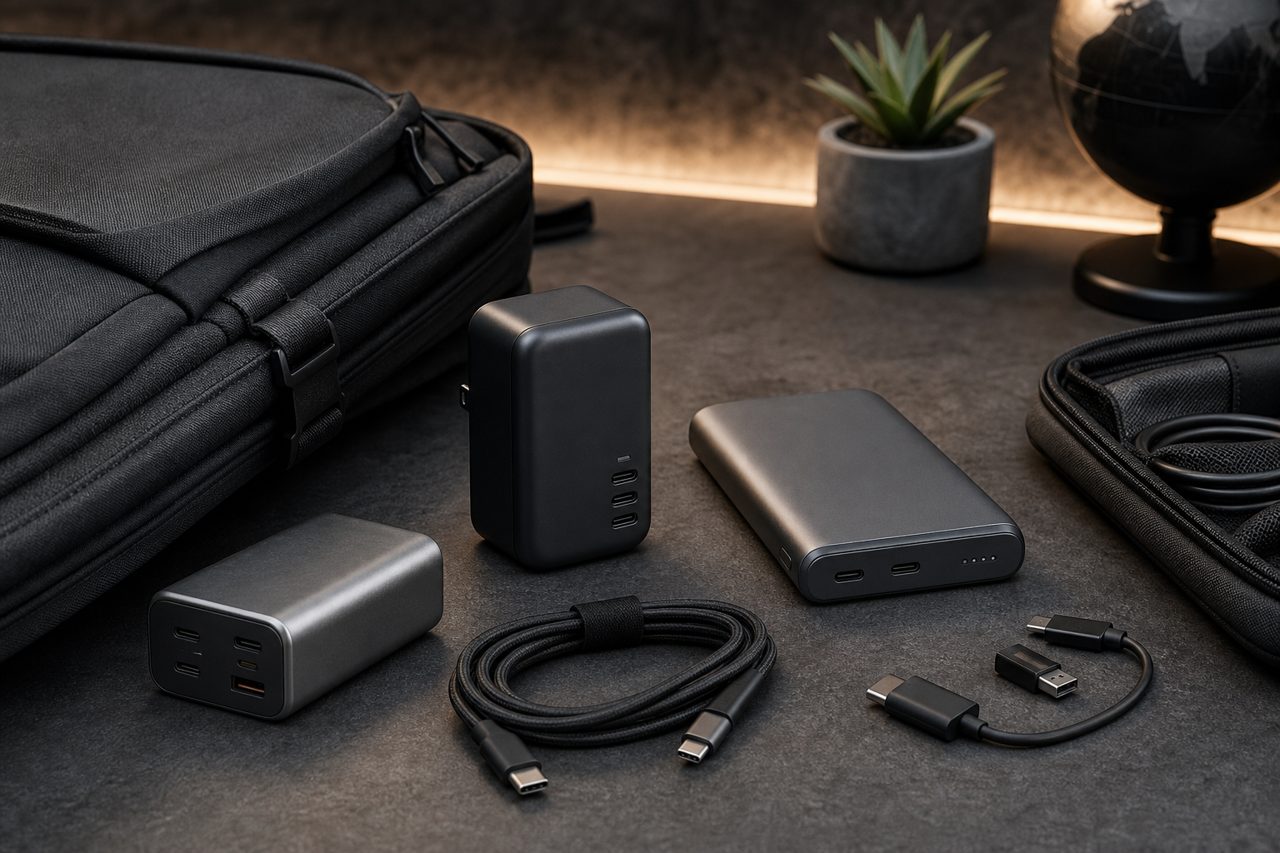
A traveler who forgets a charger faces real consequences - dead navigation, a missed connection, a hotel-room negotiation with a stranger over the only outlet. That urgency is why charging gear travels at the top of the packing list, and why a pre-assembled kit converts so well: it answers every charging question a trip could ask in a single decision. For a seller, the kit is also margin-efficient - one purchase order, one SKU, one delivery, carrying several products' worth of value.
Who buys travel kits
Four audiences keep this scenario stocked year-round. Frequent travelers buy for themselves and replace kits that get worn out or left behind - the category's built-in replacement cycle. Couples and families buy one kit that serves several devices and several people, which is why every item in the kit should support at least two use patterns. Corporate travel and procurement teams buy kits in quantity for onboarding and road-warrior programs, an orders-of-magnitude larger basket per customer. And gift buyers convert on the tidy, complete feeling of a boxed set, particularly in holiday periods.
The audiences also share a buying psychology worth naming: they are purchasing peace of mind, not electronics. The kit that shows it has already thought through the trip - outlets, redundancy, airline rules - is buying the customer's trust before the flight, and trust is the one travel product nobody returns.
The core kit, item by item
The composition below is the working core that fits a pocket of a carry-on and covers phone, tablet, laptop and backup power:
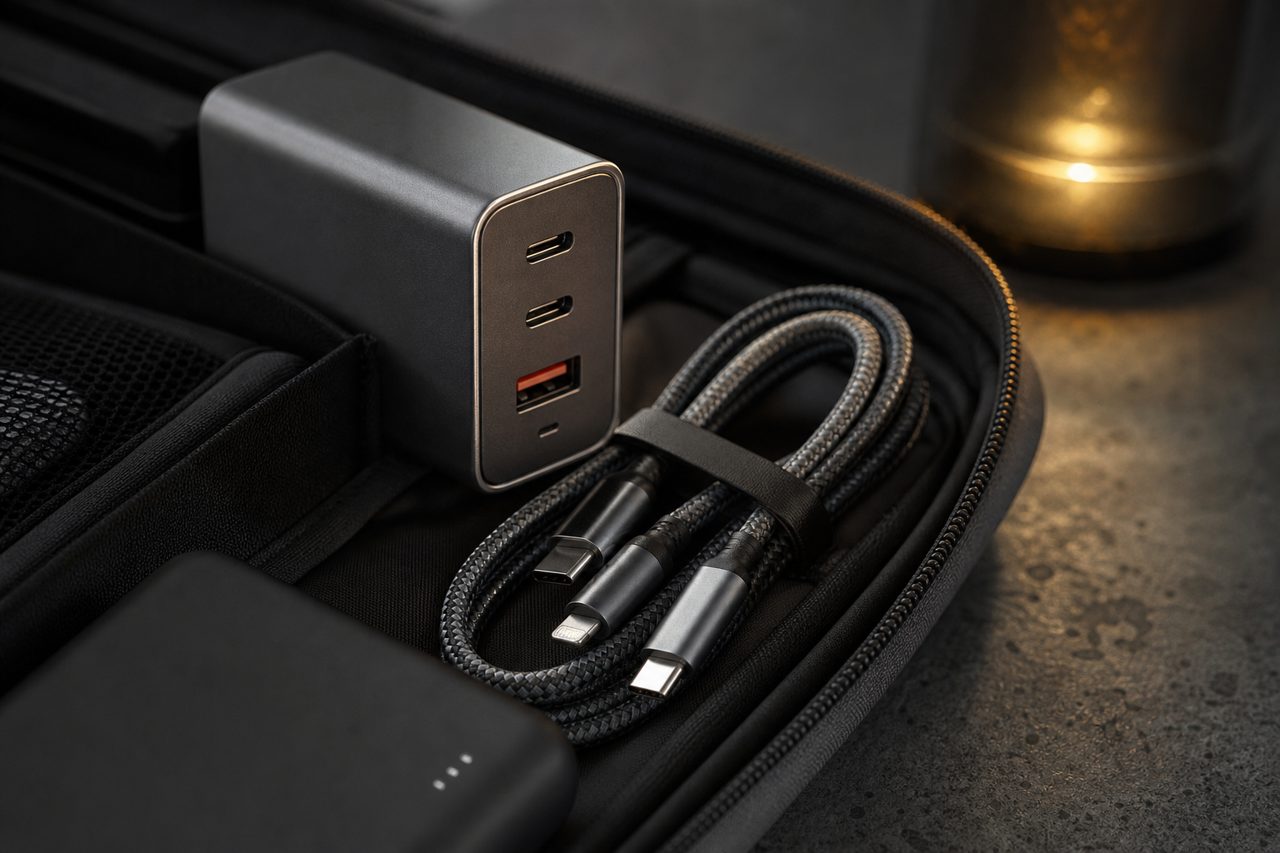
- 65W dual-USB-C GaN wall charger. The anchor. One charger handles a phone at full speed, a tablet, and compact laptops - three products replaced by one. Dual ports absorb hotel rooms with a single outlet, which is every hotel room eventually.
- Two USB-C cables rated 100W. One 1-meter cable for the bag and a 2-meter braided cable for the hotel bed across the room. Two cables is redundancy - the single most common kit failure is one cable, and a braided jacket survives luggage better than bare PVC.
- 10,000 mAh power bank (about 37 Wh). The carry-on workhorse: roughly two phone recharges, below the widely used 100 Wh consumer threshold, and sized to disappear into a jacket pocket during boarding. The capacity trade-offs are covered in our power bank capacity guide.
- Interchangeable plug heads. Regional outlets are the detail travelers forget until the arrival hall; a small set of plug heads turns one charger into a global one.
- A cable pouch. The item that makes it a kit instead of a drawer of tangled companions, and the item whose photo sells the completeness of the set.
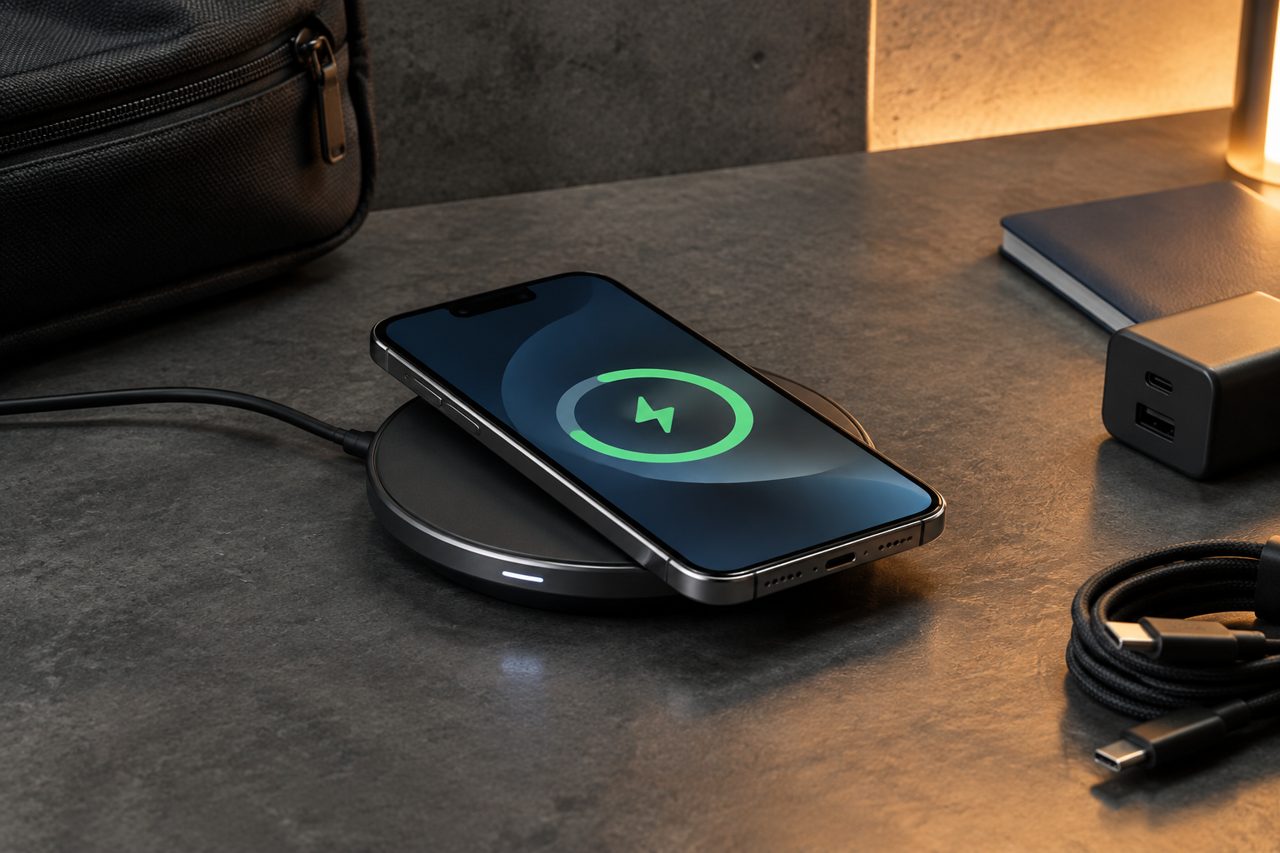
- Optional: magnetic wireless pad. For the hotel nightstand, where dropping a magnet-aligned phone onto a pad is the entire experience. Our Qi2 sourcing guide covers what to verify before including one.
Why this composition works
The kit obeys three design constraints that travelers actually feel. First, consolidation: one wall charger serving three device classes means fewer bricks, fewer outlets fought over, and a lighter bag. Second, redundancy where failure hurts: two cables and a backup bank mean no single lost item strands the customer. Third, weight discipline: every item earns its mass, and nothing in the core set requires a dedicated compartment.
GaN technology is what makes the first constraint cheap to satisfy, compressing a 65W charger into a pocketable body - the consolidation argument collapses if the anchor charger still weighs like an old laptop brick. The technical background sits in our GaN explainer; for kit purposes it is enough to know the size argument now photographs well.
Compliance is designed in rather than bolted on. The power bank's watt-hour figure sits comfortably in carry-on territory, and the listing says so explicitly - a detail covered further in our battery shipping guide. Stating the airline-friendly case on the box converts a compliance fact into a selling point at exactly the moment of doubt.
Regional variations worth planning for
The kit needs one honest look at destinations before it is final. Plug standards differ by region, so the interchangeable plug heads should match the markets your customers actually fly to - a set aimed at one region can ship with that region's plug, while a global set carries the interchangeables. Voltage is simpler: quality GaN chargers accept the full 100-240V input range printed on their housing, so one charger genuinely works worldwide once the plug fits. Expectations differ too - in some markets a legacy USB-A port or cable is still expected, and a road-trip variant of the kit with a compact 30W car charger serves destinations where driving dominates. These are assortment decisions, not afterthoughts, and they are cheapest to make when the kit is being specified rather than after reviews mention them.
Listing and packaging advice
Kits live or die on how legibly the listing communicates completeness, compliance and outcome. Six practices carry most of the weight:
- Photograph the flat-lay. A top-down photo of every item laid out communicates completeness instantly - it is the single strongest image a kit listing can carry.
- Name the outcome. Titles that say what the bag stops worrying about - one charger for phone and laptop, charged for the flight - convert better than part numbers.
- Print the watt-hours. Show 37 Wh next to the capacity, with a carry-on graphic; it pre-answers the airport question.
- Ship the kit as its own SKU. A separate bundle SKU keeps pricing and inventory coherent and prevents component discounts from cannibalizing the set.
- Add a one-page insert. A short card mapping the kit's contents to trip scenarios adds perceived value for cents.
- Anchor the price. Show the sum of components beside the kit price so the saving is arithmetic, not persuasion.
Fulfillment and customization
Kits assemble at the supplier side, which is where their logistics story gets simple: one SKU ships complete, one box, one label. Because the kit contains a power bank, it moves on the battery-compliant channel - typically 8-18 days door to door - while battery-free bundle variants ship general cargo in 7-15 days; stock dispatch happens within 48 hours either way, and photo-evidence damage replacement applies within 30 days of signing.
Validation and branding follow the standard ladder. List the kit from a single unit through dropshipping and let return reasons refine the composition; a kit-level logo and custom box run from 500 sets per SKU with 5-7 day sampling; deeper custom builds start at 1,000 sets. The charging category holds every component in this kit as an individual model, and the OEM/ODM process covers kit-level packaging and branding for corporate programs.
Quality control for a kit has one extra layer worth requiring: each component is verified against its own checklist, and the assembled set is checked as a whole - pouch fits the contents, cables coil without memory kinks, and the box closes without a wrestling match. Kits are judged by their mostforgettable detail, and the assembly stage is where those details are cheapest to fix.
FAQ
What should a travel charging kit include?
The core set: a 65W dual-USB-C GaN charger, two 100W-rated USB-C cables (1m and 2m), a 10,000 mAh power bank at about 37 Wh, and a cable pouch. Interchangeable plug heads cover international outlets; an optional magnetic pad covers the nightstand.
Can the power bank in a travel kit go in checked luggage?
No. Power banks ride in carry-on baggage on essentially all airlines. At about 37 watt-hours, a 10,000 mAh unit sits well below the 100 Wh consumer threshold - worth stating on the box as an airline-friendly feature.
How should a kit be priced against its components?
Between the sum of the parts and the largest item's price: clearly smarter than assembling separately, while keeping its own value. Keep the bundle as a separate SKU so component discounts never reset the kit's price.