What Is a GaN Charger? The Technology Explained for Buyers
GaN has become the default power-stage technology in modern chargers. This guide explains what gallium nitride actually does, what it does not do, and the checks a B2B buyer should run before adding GaN models to a catalog.
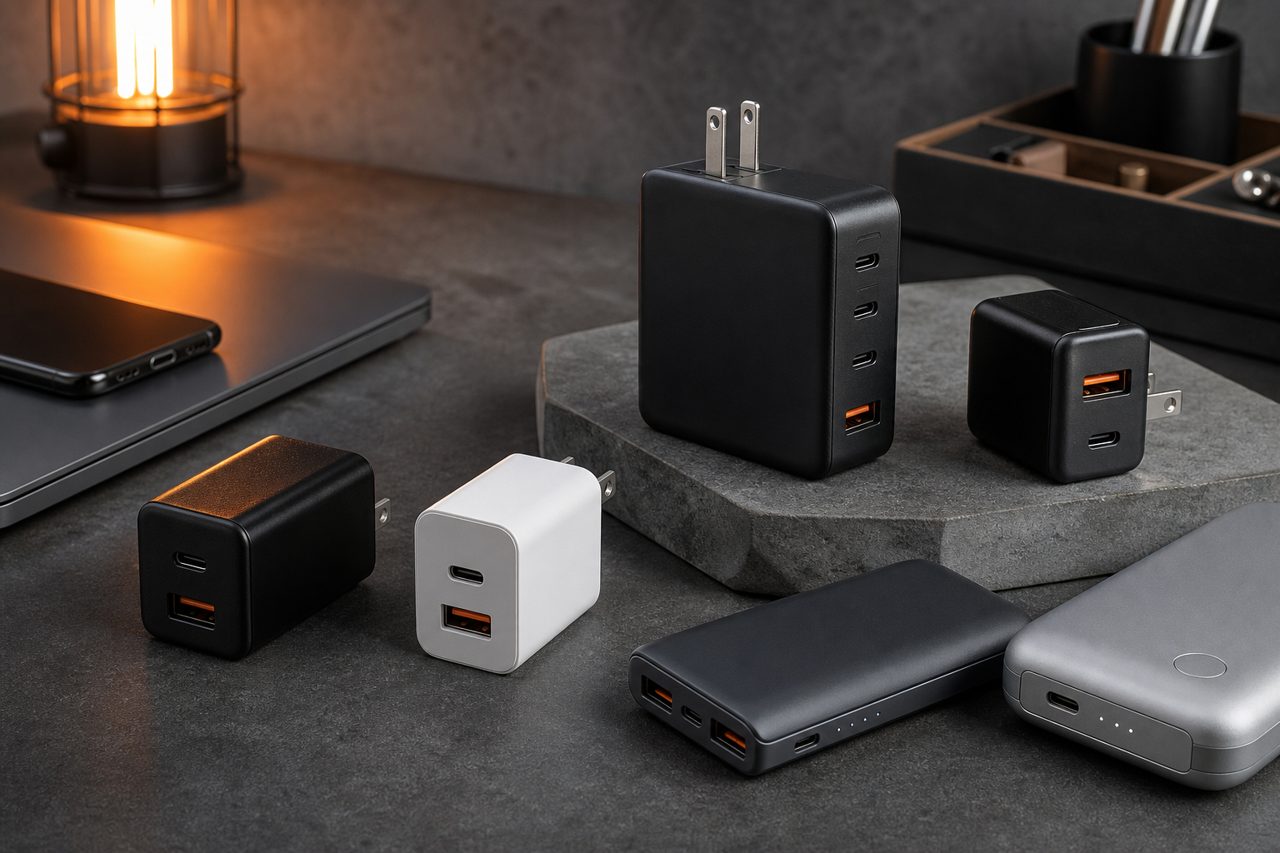
Chargers used to be defined by wattage alone. Today the first line of most spec sheets reads GaN, and retail buyers have learned to expect it. For a reseller, distributor or brand owner, the question is no longer whether to stock GaN chargers but how to tell a well-engineered model from a badge on an ordinary one. That judgment starts with a working understanding of the technology.
What GaN actually is
GaN stands for gallium nitride, a crystalline semiconductor that spent decades in LEDs and radio-frequency electronics before moving into power adapters. The property that matters for chargers is the bandgap. Gallium nitride has a wider bandgap than silicon (about 3.4 electron-volts against roughly 1.1), which means the material tolerates higher electric fields and switches on and off faster with lower losses.
Inside every charger, a power stage converts alternating current from the wall outlet into low-voltage direct current by switching transistors on and off tens of thousands of times per second. When those transistors switch faster and more efficiently, the whole architecture around them can be redesigned to use that headroom.
For most of the adapter industry's history, silicon set the pace. Each new watt class arrived in a slightly smaller body, but the physics of silicon switching limited how far designers could push the format, which is why a laptop charger stayed a brick for so long. Wide-bandgap materials broke that ceiling, and gallium nitride was the first of them to reach mass production at consumer price points.
Why GaN chargers are smaller and cooler
The volume of a conventional charger is dominated by its transformer and filter capacitors. Both scale down as switching frequency rises, because high-frequency magnetics need far less material to transfer the same energy. GaN transistors switch much faster than their silicon predecessors, so designers raise the frequency, shrink the transformer and cut heat at the same time.
The results are the ones end customers notice on the shelf:
- A 65W charger in a body once reserved for 30W models, light enough for a jacket pocket.
- Two or three USB-C ports sharing high total output inside a single compact housing.
- Lower surface temperature under load, which protects both the internal components and the housing finish.
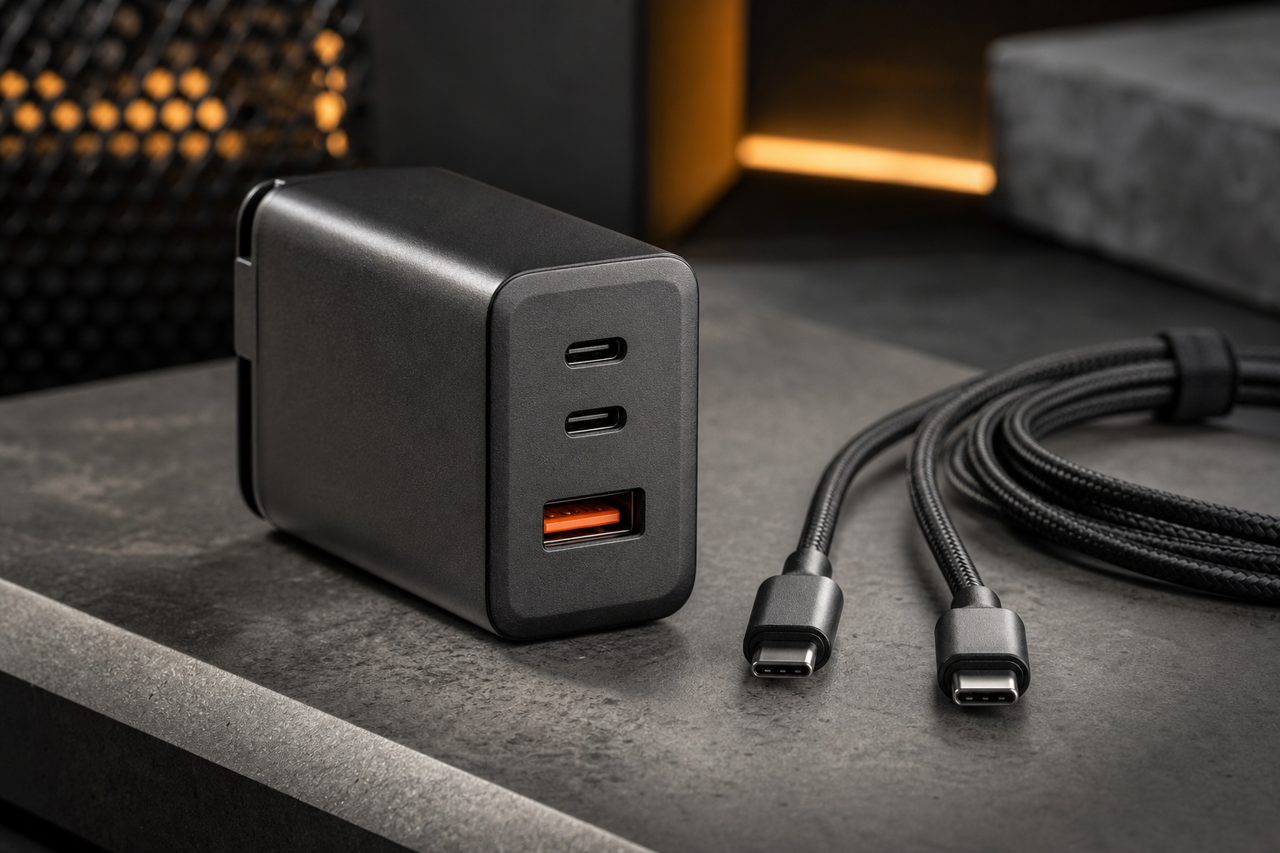
None of this is cosmetic. Size and heat are the two attributes buyers compare first, and GaN is the technology that improves both at once.
What GaN does not change
GaN is the power stage, not the brain. Fast-charging speed is negotiated by protocol chips running standards such as USB Power Delivery, with PPS profiles for fine-grained voltage control. A GaN charger with weak protocol support will still charge a phone slowly, and a well-tuned silicon design can outperform a poorly tuned GaN one. When you evaluate samples, judge the negotiation levels and multi-port behavior, not the semiconductor on the bill of materials.
Reliability lives elsewhere too: over-voltage, over-current and over-temperature protection circuits, the grade of the capacitors, assembly quality, and the certification file behind the exact model. GaN lowers heat, which helps longevity, but it is not a substitute for a protection design or a compliance file. Our overview of charger certifications by market covers the paperwork side in detail.
What the market data says
Market signals indicate that GaN has moved well past the early-adopter stage. Precedence Research sizes the global GaN charger market at USD 1.06 billion in 2024 and projects USD 9.75 billion by 2034 (Precedence Research, 2024-2034). Set against the wider mobile accessories market, valued at USD 105.5 billion in 2025 and projected to reach USD 189.9 billion by 2033 (Grand View Research, 2025), charging is the subcategory where component-level upgrades are most visible to end customers.
The takeaway for a reseller or brand owner is direct: at 65W and above, GaN is no longer a premium differentiator. It is the baseline expectation, and stocking silicon-only high-wattage models means competing on price against products that look smaller and run cooler at the same rating.
Geography reinforces the point. Asia Pacific accounted for 49.9 percent of the global mobile accessories market in 2025 (Grand View Research, 2025), and the charging segment concentrates in the same Shenzhen supply belt that produces the underlying components. Sourcing GaN models close to the component ecosystem shortens the path from spec sheet to shelf, and it is the main reason charging categories moved to direct-from-source procurement.
What to verify before you stock a GaN model
Treat every new GaN SKU the same way, regardless of how a listing looks. The table below is the minimum spec-sheet review we recommend before samples are ordered.
| Spec line | What to check | Why it matters |
|---|---|---|
| Per-port output profiles | Fixed levels (5V/9V/12V/15V/20V) and PPS ranges actually supported | Real speed depends on negotiation, not the wattage printed on the box |
| Total vs per-port power | How output splits when two or three ports are in use | The most common source of complaints on multi-port models |
| Protection circuits | Over-voltage, over-current, over-temperature, short-circuit | Drives warranty cost and marketplace safety claims |
| Efficiency and standby draw | Conversion efficiency under load and no-load consumption | Affects heat, energy use and eco-claim eligibility |
| Certification file | CE, FCC, RoHS and market-specific certificates for the exact model | Customs clearance and platform listings depend on them |
| Housing and plug | Flame-retardant housing grade, folding or interchangeable plug | Shapes perceived value and destination-market fit |

After the paper review, a short bench protocol settles the rest. Verify the negotiated profile on each port, run a two-port load test to see how power actually splits, and log surface temperature after twenty minutes at full rated load. Because stock models leave our warehouse within 48 hours of order, this validation loop takes days rather than weeks.
Where GaN shows up in a charging catalog
GaN first conquered three product forms, and they remain the core of any charging assortment:
- Wall chargers. Single- and dual-port models from 30W to 65W, where the size advantage is easiest for customers to feel.
- Multi-port desktop chargers. The 100W class and above, where the compact magnetics make four or more ports practical in one housing.
- Car chargers. High per-port output inside a housing that still has to fit a 12V socket, a packaging problem GaN solves neatly.
These three forms cover most demand profiles, and each carries the same verification list from the table above. The wattage you lead with should follow your audience, which is a portfolio question we treat separately in the wattage comparison.
From one test unit to a branded line
GaN is one of the easiest categories to scale from testing to private label. Stock models ship from a single piece, so you can validate demand through dropshipping before committing capital. Once a model proves itself, logo printing and retail packaging start at 500 pieces per SKU, and full OEM with a custom housing starts at 1,000 pieces per SKU, with structural changes from 3,000. Sampling takes 5-7 days for light customization and 7-12 days for full OEM, with volume production in 12-15 and 25-35 days respectively. Browse the current charging lineup or review the OEM/ODM process to match the sourcing model to your stage.
FAQ
Do GaN chargers charge devices faster than silicon chargers?
Not by themselves. Charging speed is negotiated through USB Power Delivery profiles. GaN enables a smaller body and higher total power, which makes compact fast chargers practical, but speed still comes from the protocol match between charger, cable and device.
Are GaN chargers safe?
Safety depends on the protection circuits, component grade and certification file behind the specific model, not on the semiconductor alone. GaN runs cooler at the same output, which helps longevity, but buyers should still verify over-voltage, over-current and over-temperature protections and request certificates for each target market.
What is the MOQ for custom GaN chargers?
Stock models ship from one piece for dropshipping validation. Logo printing and custom packaging start at 500 pieces per SKU; full OEM with a custom housing starts at 1,000 pieces per SKU, with structural changes from 3,000.