Car Charger Buying Checklist for Retailers
Car chargers are the quiet compounder of a charging assortment: small, battery-free, attached to every driver, and replaced whenever a car or a phone changes hands. This checklist turns the category into a repeatable sourcing procedure.

Of all charging products, car chargers carry the best ratio of commercial value to sourcing complexity. They contain no lithium battery, so the compliance and logistics burden that shapes the rest of the category largely disappears - they travel as general cargo. They attach naturally to phone accessory purchases, they live in a vibration-and-heat environment that eventually wears out every unit, and the installed base - every driver with a phone - keeps regenerating demand. The category rewards retailers who source carefully, because a car charger that rattles loose or overheats in summer traffic generates exactly the reviews a store cannot afford.
The product's context also keeps upgrading itself. Phones are now the navigation, entertainment and communication hardware in most vehicles, fast-charging has trained buyers to expect serious wattage from a small socket, and device upgrades cascade into accessory upgrades. None of this requires invention to merchandise - it requires a supplier whose models pass the checklist below.
The ten-point sourcing checklist
Use the following list as the standing template for evaluating any car charger model. Each point is phrased so it can go directly into a request for quotation.
- Input voltage range 12-24V. Covering both passenger cars and trucks or commercial vehicles doubles the addressable base at no design cost.
- Per-port power of at least 30W on USB-C. Modern phones fast-charge through USB Power Delivery at that level; 45W-65W on one port serves buyers who want laptop capability.
- A stated total output and split rule. What happens when both ports are in use should be printed on the box, not discovered in reviews.
- PD with PPS support. PPS lets phones negotiate fine-grained voltage, which improves speed and thermal behavior on a broad range of devices.
- A complete protection set. Over-voltage, over-current, over-temperature and short-circuit protection, plus tolerance for the voltage spikes a vehicle electrical system can produce.
- Contact retention and fit. The charger must stay firm in the socket under vibration - spring contacts and a snug body are quality signals a sample reveals immediately.
- Housing material with a heat story. Flame-retardant engineering plastic or an aluminum body that dissipates heat; surface temperature under load should be measured, not assumed.
- A replaceable fuse. A mini fuse the end user can swap turns a potential return into a ten-second fix.
- Sensible port mix. Dual USB-C for new devices; one USB-A legacy port widens compatibility for families and older devices.
- Certification matched to destination. CE for Europe, FCC for the United States, RoHS where applicable - ask which certificates exist for the exact model.
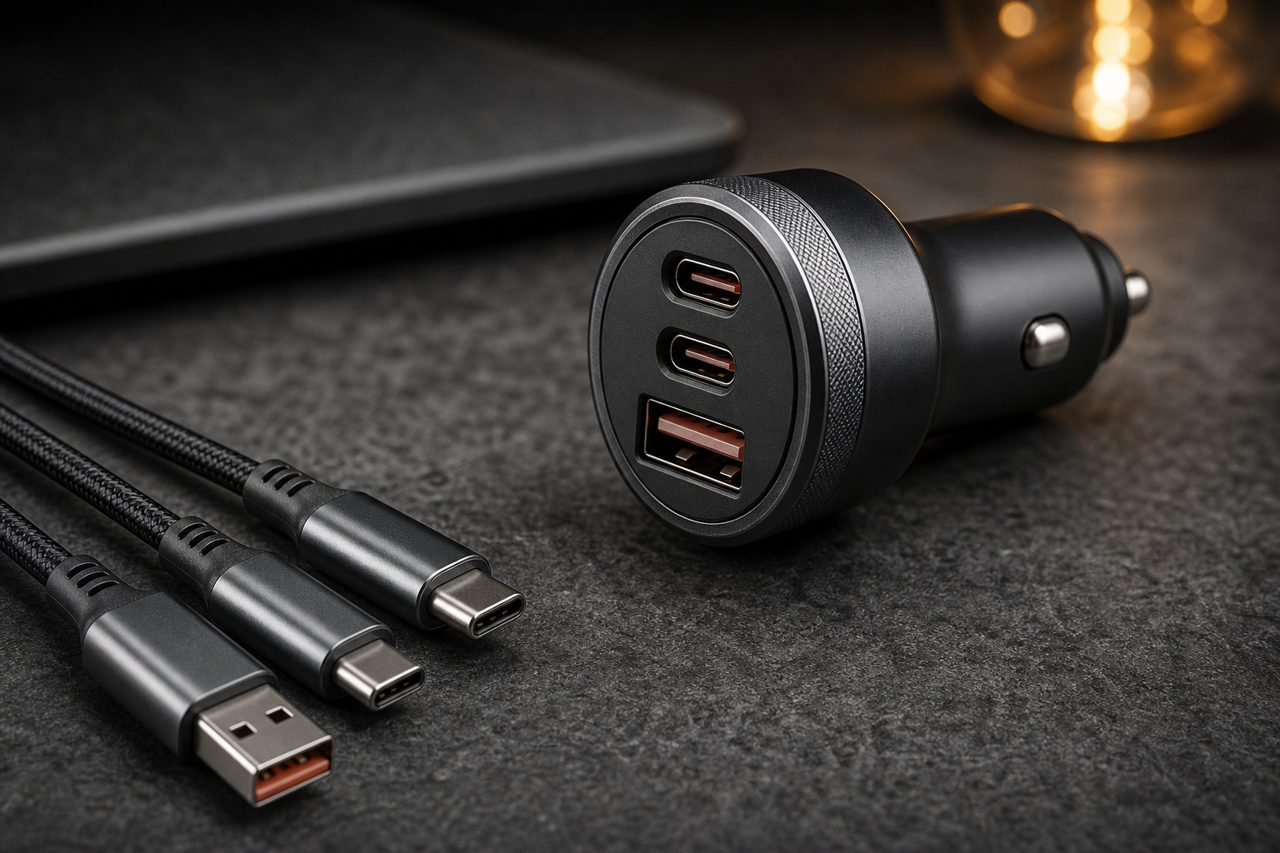
Baseline specification table
Where a checklist item needs numbers, this table gives baselines that work for a general-audience assortment. Treat them as procurement anchors, not ceilings.
| Parameter | Baseline specification | Notes |
|---|---|---|
| Input voltage | 12-24V DC | Covers cars, SUVs, trucks and commercial fleets |
| Per-port output | 30W PD minimum; 45-65W for the premium model | Verify the negotiated profile, not the box claim |
| Total output | 45-100W depending on tier | State the split rule for simultaneous use |
| Protocols | PD with PPS; broad backward compatibility | Confirm on a protocol analyzer during sampling |
| Protections | OVP, OCP, OTP, short-circuit, input surge tolerance | Ask how surge tolerance is implemented |
| Housing | Flame-retardant PC or aluminum alloy | Check surface temperature after 20 minutes at full load |
| Fuse | Replaceable mini fuse | Include a spare in the retail box where possible |
| Certifications | CE, FCC, RoHS as applicable | Certificates must name the exact model |
A ten-minute sample test
The checklist compresses into a short physical test that any buyer can run with a sample, a phone, and a basic USB power meter:
- Seat it and shake it. Push the unit into the socket, then tug and twist it the way a road would. It should not back out, and the contact should not flicker.
- Load both ports. Connect devices or load testers to both ports at once and read the delivered power on the meter - this is the split rule, verified rather than promised.
- Hold the load for twenty minutes. Feel the housing and note when the surface gets uncomfortable; excessive heat predicts throttling and short product life.
- Check the handshake. A phone should negotiate its fast-charge profile within seconds of connection, on each port in turn.
- Listen. Any buzz, rattle or loose-part noise inside the housing at this stage becomes a review at month three.
Ten minutes of this procedure before each purchase order replaces months of review-reading afterward, and it needs no laboratory - only discipline about actually doing it.
Failure modes that become returns
Car chargers fail in predictable ways, and each failure mode maps to a checkpoint above. Poor socket contact is the leader: a charger that works loose on rough roads reads as "stopped charging", and the return reason never mentions vibration. Heat is second - a unit that throttles or shuts down in summer traffic gets blamed for the phone's slow charge. The fuse that sacrifices itself during an electrical spike is doing its job, but only a replaceable one converts that success story into a non-event. Rattles and LED indicators bright enough to distract a driver at night are aesthetic failures with real review consequences.
Every one of these is testable on a sample before an order, which is what makes this category so tractable: a week of sampling and a short bench session eliminates most of the returns a careless purchase order would have purchased. Our GaN charger guide covers the bench protocol in more depth, and the same method transfers directly to car models.
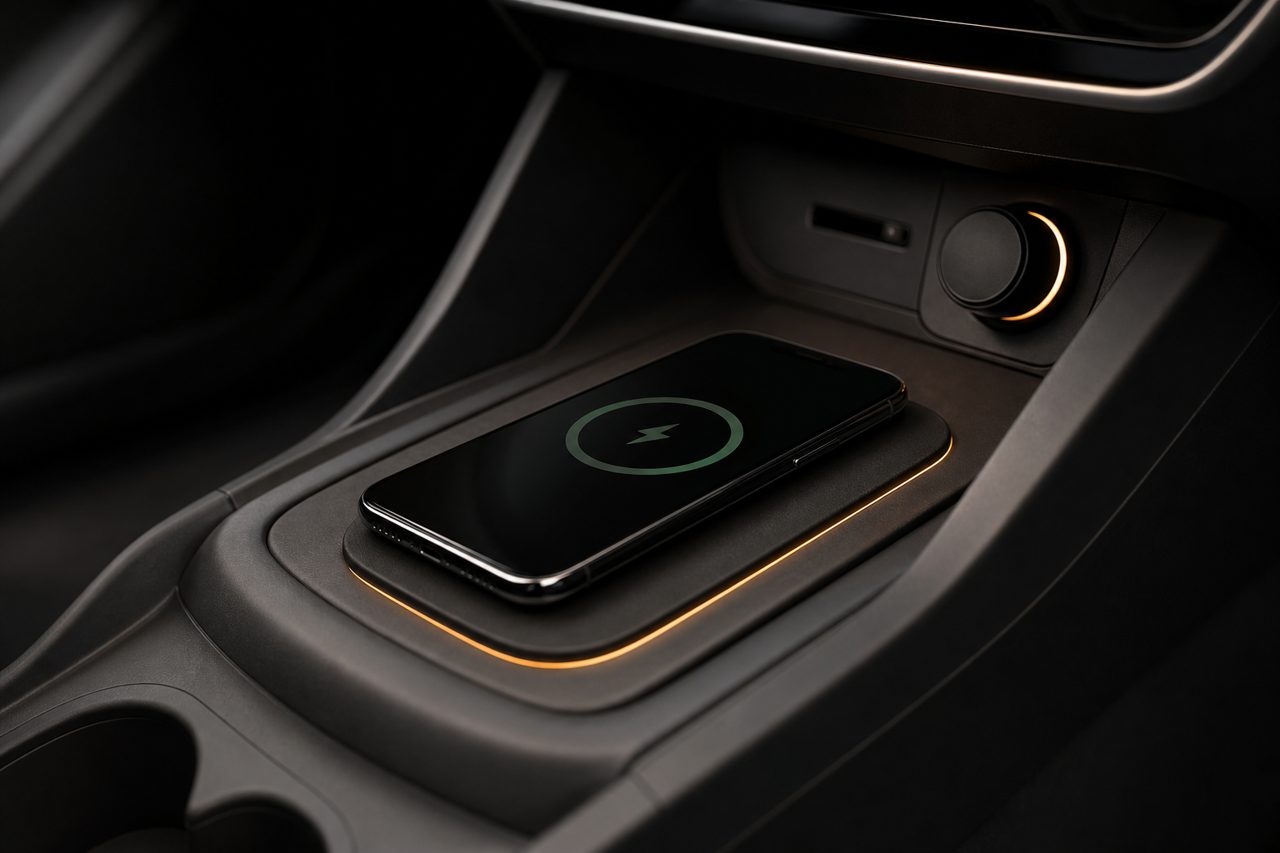
Positioning and bundling
Car chargers sell in predictable contexts, and the merchandising can lean on them. As an attach item beside phone cases and cables, a compact 30W unit converts on convenience. For family vehicles, a dual-port model with one legacy USB-A port covers mixed device fleets. For buyers in ride-heavy professions, a 45W-65W unit that can genuinely top up a laptop becomes a work tool. Each context suggests its own listing copy and its own cable bundle - a car charger without a cable is half a purchase for many customers.
Seasonality rewards planning here as well. Road-trip season, back-to-school periods and holiday travel all push car accessories into gift territory, and a bundled charger-plus-cable set photographed in a center console sells the scenario rather than the specification. None of that costs extra to stock if the bundling decision is made at purchase-order time rather than improvised at listing time.
Logistics and customization
The battery-free design pays off twice in operations. On logistics, car chargers ship as general cargo on the 7-15 day channel, with no UN38.3 file requirements attached - a contrast with the rest of the charging category, as covered in our battery shipping guide. On sourcing, the same ladder applies: validate demand from one piece through dropshipping, add a logo and retail box from 500 pieces per SKU with 5-7 day sampling, and commission a custom housing from 1,000 pieces. The charging category lists current car charger models with their specification sheets, and the OEM/ODM process supports branded versions for fleet programs and retail packaging.
Operational guarantees carry over unchanged: stock dispatch within 48 hours, and photo-evidence damage replacement within 30 days of signing - terms that matter proportionally more in a category where units live in cupholders and door pockets and lead harder lives than their desk-bound cousins.
FAQ
What wattage should a retail car charger deliver?
A workable baseline is 30W per port over USB Power Delivery for current phones; 45W-65W on one port covers buyers who want laptop capability in the car. Per-port rating matters more than the total, so state the split behavior on the box.
Will a car charger drain the vehicle battery?
Not meaningfully while driving - the alternator supplies the circuits. Most modern vehicles cut the 12V socket at ignition off, and a quality charger keeps standby draw minimal. The concern applies mainly to older vehicles that keep the socket live.
Do car chargers need certifications?
Yes, by destination market: CE for Europe, FCC for the United States, RoHS where applicable. A car charger has no lithium battery, so UN38.3 air-cargo rules do not apply, but the device itself still needs market compliance.