MagSafe-Compatible Accessories: What Resellers Must Know
Magnetic alignment has reset what customers expect from wireless charging. This guide explains what magnetic compatibility involves, where the trademark boundaries sit, and which product checks matter before a reseller lists its first magnetic SKU.
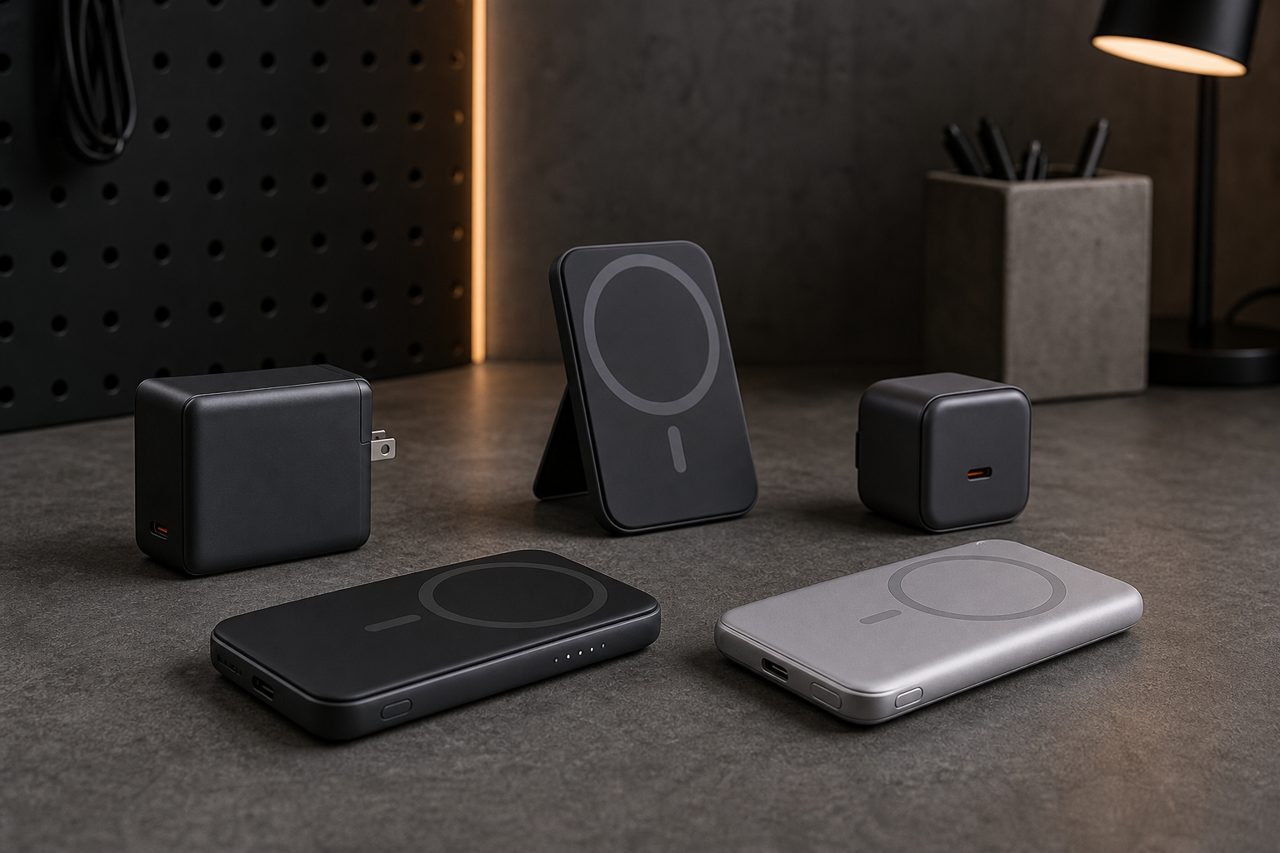
Magnetic wireless accessories moved from novelty to default in a short time, and the direction of travel is clear. The global wireless charger market is forecast to reach USD 19.0 billion by 2030, growing at 22.9% a year (Grand View Research, 2025), and magnetic alignment is the feature end customers now associate with the category. For a reseller, that creates a wide opportunity with one uncomfortable detail: the most searched term in the niche belongs to a single device maker. Handling that detail well is what separates a durable accessory line from a takedown notice.
What the magnetic ecosystem actually is
A magnetic wireless charger is a Qi charging coil surrounded by a ring of permanent magnets. The magnets do not transfer power; they position the phone so its receiver coil sits directly over the charger coil. That alignment is the whole value proposition. Poorly aligned coils waste energy as heat, which triggers thermal throttling, which customers experience as slow charging. A magnet ring solves the alignment problem mechanically instead of asking users to find the sweet spot by hand.
The approach proved so effective that the industry standardized it. The Qi2 specification, maintained by the Wireless Power Consortium, is based on the magnetic power profile pioneered by the device ecosystem that made it popular, and Qi2.2 raised the wireless power ceiling from 15W to 25W (Wireless Power Consortium, 2025). Alignment is no longer a brand trick; it is the standard the whole accessory industry builds against. Our earlier Qi2 sourcing guide covers the standard itself in depth.
For buyers, the practical consequence is a two-part product: the electrical side is defined by Qi certification and protocol support, and the mechanical side is defined by magnet strength, ring diameter and ring position. Both halves must be verified, because a charger can be electrically flawless and still fail in the market if the magnets misalign with popular phones and cases.
In practice, the electrical and mechanical sides age differently. Coil specifications and protocol support are stable across a production run, while magnet assemblies are where variance shows up first, because adhesive thickness, ferrite positioning and housing tolerances each shift alignment by fractions of a millimeter. That is why repeat orders of an unchanged SKU still deserve a spot check on alignment and holding force, and why the bench checks below belong in every re-order cycle.
The trademark boundary every reseller should settle early
The term at the center of this niche is a registered trademark of the device maker that introduced it. Selling a compatible product is legitimate; implying endorsement, origin or certification by that brand is not. Marketplaces enforce this inconsistently but unpredictably, and the cost of getting it wrong is a delisted SKU, not a warning letter. The safe pattern used by established accessory brands is simple: lead with neutral, standard-based wording and keep any reference to compatibility factual.
| Wording on the listing | What it claims | Risk for a reseller | Recommended use |
|---|---|---|---|
| Magnetic wireless charger | Describes the product mechanism | Low | Default term for titles and packaging |
| Qi2 certified | Certification through the Wireless Power Consortium | Low, with a valid certificate | Use only for certified models and SKUs |
| Works with magnet-aligned phones | Factual compatibility statement | Low to moderate | Acceptable in bullets, phrased plainly |
| Trademarked name as a noun for the product | Implies the product belongs to that brand line | High | Avoid in titles, images and packaging |
| Brand-styled naming or logos | Implies endorsement or origin | High | Never; creates takedown and legal exposure |
Two further habits keep listings safe. First, keep the trademark out of product images: no logos, no device-brand styling, no packaging that mimics the original maker's shelf look. Second, document compatibility honestly. If the magnet ring aligns with the dominant phone and case formats, say exactly that, with the ring diameter and offset in the spec sheet. Facts survive platform reviews; impressions do not.
What compatible must mean technically
Compatibility claims fail on measurable details, and buyers should turn each one into a sample-check step:
- Ring diameter and position. The magnet ring must match the alignment array used by current phones and magnetic cases, or the charger holds weakly and twists off-center.
- Holding force. Too weak and the phone slides in a car or on a stand; too strong and one-handed removal becomes a complaint driver. Ask for the holding-force figure and test it on your own device.
- Coil alignment under load. Confirm that the negotiated power stays stable when the phone sits in the aligned position, including through a typical case.
- Through-case charging. Most users leave cases on. Verify charging and magnet grip through a case of realistic thickness, not on a bare device only.
- Foreign object behavior. Metal rings, plates and cards between charger and phone should trip the detection circuit, not overheat.
None of these checks needs a laboratory. A force gauge, a protocol meter and an afternoon cover the list. What matters is that the checks happen before the purchase order, because magnet specification is the one area where a sample that looks right can still be built wrong.
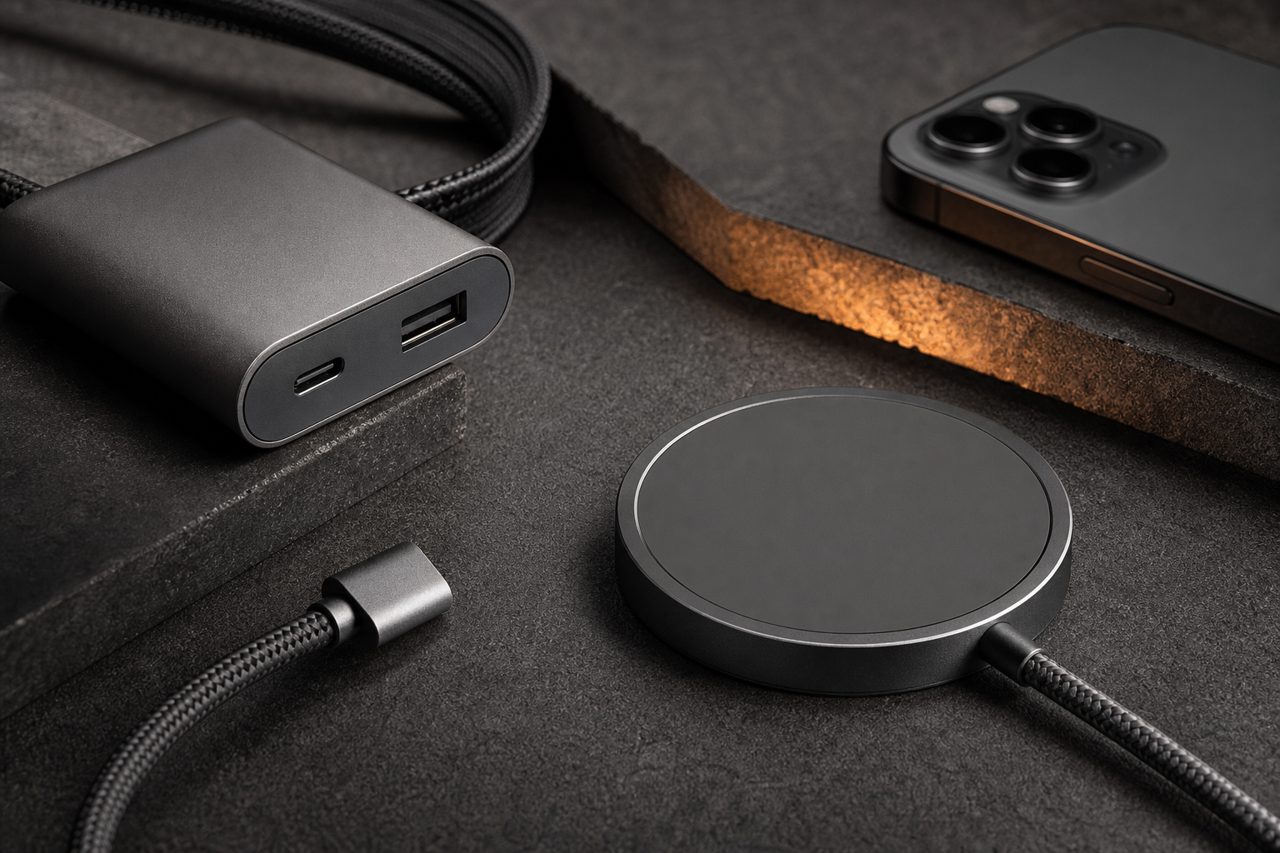
Building a magnetic accessory line
The magnetic ecosystem extends well beyond the flat pad, and a balanced catalog spreads risk across formats with different price points:
- Magnetic wireless chargers. Pads and stands from 15W to 25W; the entry point of the category and the volume driver.
- Magnetic power banks. Snap-on packs that charge while held, increasingly paired with a foldable stand; a strong bundle candidate.
- Magnetic car mounts with charging. The format where holding force matters most, since vibration and heat punish weak alignment.
- Magnetic cases and plates. The attach-rate product that makes the rest of the line sticky; sold as companions rather than heroes.
Position these as a system: chargers and mounts sell better when cases are listed alongside, and returns drop when listings state which formats each product aligns with. The charging lineup covers the current stock models across these four formats.
From sample to shelf with a source supplier
Magnetic accessories are well suited to staged sourcing. Stock models ship from a single piece, so demand can be validated through dropshipping before any capital is committed. Once a model proves itself, logo printing and custom packaging start at 500 pieces per SKU, and full OEM with a custom housing or fixture starts at 1,000 pieces per SKU, with structural changes from 3,000. Sampling takes 5-7 days for light customization and 7-12 days for full OEM, with volume production in 12-15 and 25-35 days respectively.
Customization is also where the trademark discipline pays twice: a strong house brand built on neutral magnetic and Qi2 wording is an asset that no platform dispute can take away. Buyers planning that route can review the OEM/ODM process, including tooling for magnet fixtures and housing design.
One sequencing note from experience: validate the stock model first and move to packaging customization second. Buyers who reverse the order often redesign boxes twice, because the listing angle that survives testing is rarely the one assumed at the start.
FAQ
Can we list accessories as MagSafe-compatible?
Treat the term as a compatibility statement referencing another company's trademark, not as a product name. The safe pattern is to lead with neutral wording such as magnetic and Qi2, keep any compatibility reference factual, and follow the brand policies of each platform and market.
Do magnetic chargers need Qi2 certification to advertise 25W?
The Qi2.2 specification defines 25W wireless output. Using the Qi2 name and marks on packaging or listings requires certification through the Wireless Power Consortium; without it, describe the measured capability in plain terms.
What is the MOQ for custom magnetic accessories?
Stock models ship from a single piece for dropshipping validation. Logo printing and custom retail packaging start at 500 pieces per SKU; full OEM with a custom housing or magnet fixture starts at 1,000 pieces per SKU, with structural changes from 3,000.