Factory vs Trading Company: 10 Checks Before You Wire Money
"Is this a real factory?" is the wrong first question. The right question is whether the counterparty can prove what they claim, stand behind it in writing, and be found again if something goes wrong. Here is the checklist that answers that, regardless of the label on the business card.

Every sourcing guide tells buyers to "find a factory, not a trading company," as if the label on a business card settled the risk. It does not. Some trading companies run tighter quality control than the factories they contract, because their whole business depends on catching problems before a customer does. Some single-line factories cannot make anything outside their one product and will subcontract the rest without telling you. The label is a proxy for something buyers actually care about - accountability - and proxies are worth replacing with direct checks.
Why the label misleads in 3C accessories specifically
The 3C accessories category makes this especially true. A charging catalog spans GaN chargers, power banks, wireless pads and car chargers - different tooling, different certification paths, different component supply chains. No single factory floor produces all of that well, let alone the audio, wearables and creator-gear categories layered on top. A counterparty who owns one assembly line and calls everything else "in-house" is stretching the truth further than a transparent trading company who says plainly: "we manufacture chargers ourselves and source audio from an audited partner factory."
What matters is not which model a supplier uses, but whether they disclose it and back it with documentation you can verify.
The 10-point check
| # | Check | What it tells you |
|---|---|---|
| 1 | Business license name matches the contracting entity and bank account | Confirms who you are actually dealing with legally |
| 2 | Ask directly which SKUs are made in-house vs. sourced from partner factories | A transparent answer is more valuable than a claimed factory tour |
| 3 | Request the test report for the exact SKU and revision, not a generic certificate | Certificates are often issued per product family, not per revision - the details matter |
| 4 | Cross-check the certificate number against the issuing lab or notified body where the scheme allows public lookup | Catches expired or reused certificate numbers |
| 5 | Ask for photos or a live video walk-through of the specific production line during your order, not a stock factory video | Distinguishes current capacity from marketing footage |
| 6 | Check whether sample lead time matches the stated model (in-house vs. subcontracted samples usually differ by several days) | Mismatched timelines are an early signal of an undisclosed subcontract |
| 7 | Request a third-party pre-shipment inspection report before final balance payment | Independent verification that does not rely on the seller's own word |
| 8 | Review payment terms: is 100% requested upfront, or does the structure release balance against inspection or shipping documents | Balanced terms indicate the counterparty is confident in delivering what was agreed |
| 9 | Ask how warranty claims and replacement parts are handled after shipment | Reveals whether there is an actual after-sales operation or just a sales desk |
| 10 | Search the company name and any known aliases for dispute history on B2B platforms | Past disputes, especially unresolved ones, are the strongest risk signal available |
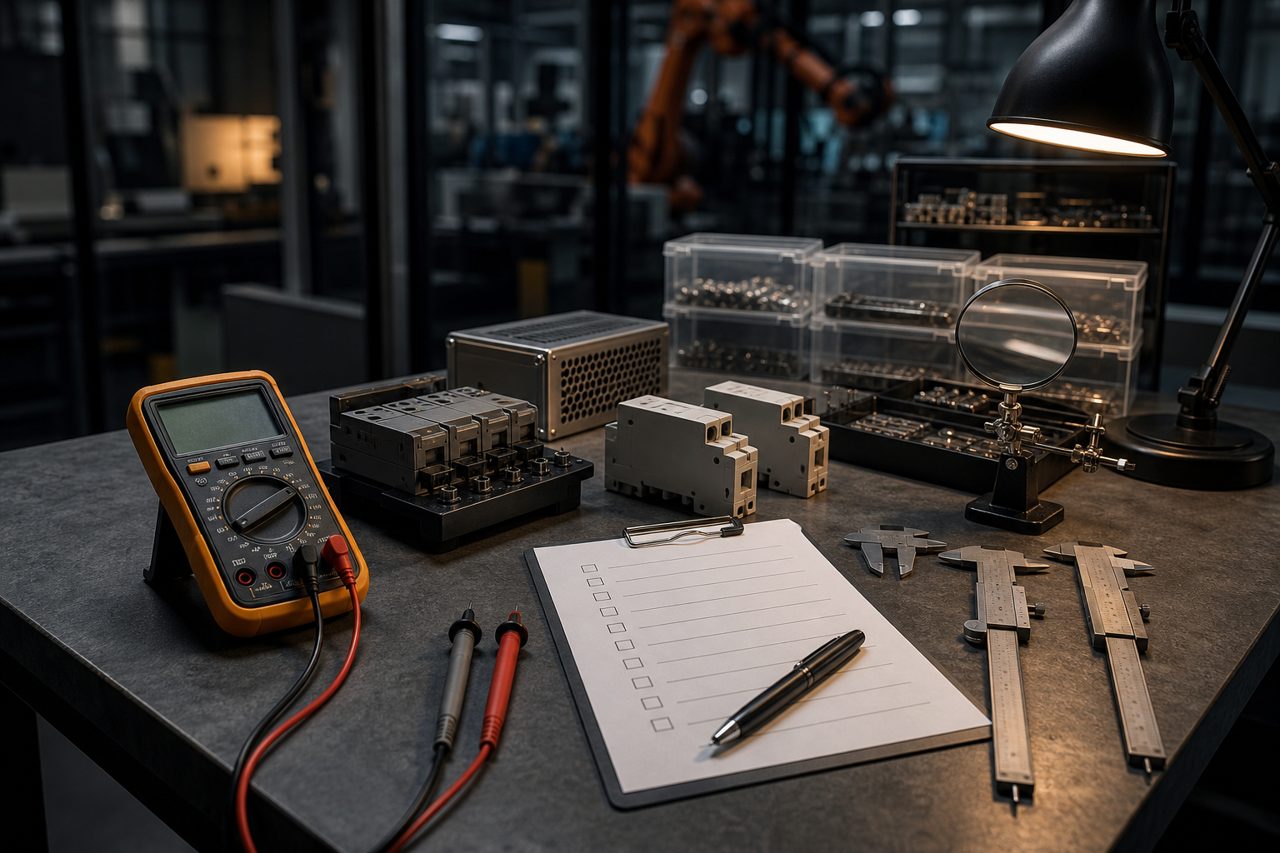
Reading the answers, not just collecting them
The checklist works because of how a counterparty responds, not only what they say. A supplier who answers check #2 with specific SKU-by-SKU honesty, who does not flinch at check #7, and who offers balanced terms on check #8 without being asked twice is behaving like an accountable party regardless of their factory ownership. A supplier who deflects, offers only stock photography, or insists on 100% upfront with no inspection option is a risk regardless of how many "OEM factory" banners appear on their storefront.
Certification cross-checks deserve particular care in 3C accessories, where CE marking, FCC and battery documents such as UN38.3 and IATA PI967 are frequently the target of forged or reused paperwork. A certificate number that does not resolve on a public registry, or that is dated years before the product revision you are ordering, is grounds to pause the order regardless of everything else on the checklist.

Red flags that surface after the checklist, not on it
The 10-point check catches most risk, but a handful of warning signs only appear once a relationship is underway rather than during the first round of due diligence. Watch for a counterparty who becomes noticeably harder to reach once a deposit clears - slower replies, vaguer answers, a shift from a named contact to a generic sales inbox. This pattern often precedes a quality or delivery problem the supplier is not yet ready to disclose.
A second pattern worth flagging: pricing that drops sharply on a reorder without a corresponding change in specification. A legitimate cost reduction usually comes with an explanation - a component substitution, a process change, a volume discount tier - and a supplier who cannot explain why the same product suddenly costs 20 percent less may be quietly substituting a cheaper component or skipping a testing step to protect margin. Ask directly what changed, and treat "nothing, just a better price for you" as an answer that needs a follow-up question, not an acceptance.
A third pattern is inconsistency between what a factory tour shows and what production documents describe. If a video walk-through shows a production line running a different product than the one on your purchase order, or shows a line configuration that does not match the process described in your quality documentation, that mismatch is worth resolving before the next payment milestone rather than after.
A source supply-chain service provider as a middle path
Between "find your own factory" and "trust a trading company blind" sits a third model that has grown across Shenzhen's accessories belt: a source supply-chain service provider that consolidates a network of audited factories under one accountable counterparty, runs its own quality inspection on incoming production, and stands behind the paperwork with a single point of contact. This is the model TECHORIGIN operates - manufacturing core charging and cable lines directly while sourcing audio, wearables and creator gear from partner factories inspected under the same quality protocol described on our quality page, with the whole network visible on the factory page.
The advantage for a buyer is not avoiding the factory-vs-trading-company question but never having to answer it alone: one contracting entity, one set of terms, one inspection standard across categories that no single factory could cover consistently.
Before you wire the balance
Run the 10-point check on any new counterparty, and treat vague or evasive answers as the disqualifying signal they are. Start new relationships with stock-item orders that can ship in a single piece through dropshipping, where the capital at risk is small enough to absorb a bad answer, before committing to OEM volumes where the checklist matters most.
FAQ
Is a trading company always worse than a factory?
No. A well-run trading company or source supply-chain service provider that consolidates a vetted factory network can offer more category breadth and more consistent quality control than a single-line factory, especially across 3C accessories categories where no one factory makes chargers, cables, audio and wearables equally well. The distinction that matters is transparency, not the label.
What documents should a supplier provide before a bulk payment?
A business license matching the contracting entity, the specific test reports and certificates for the exact SKU ordered (not a generic factory certificate), a signed pre-shipment inspection report, and payment terms that release the balance against inspection or shipping documents rather than 100 percent upfront.
How does TECHORIGIN position itself in this distinction?
TECHORIGIN operates as a source supply-chain service provider based in Shenzhen's Bao'an district, consolidating a network of audited factories across the six accessory categories, with in-house quality inspection and fulfillment rather than reselling from unverified suppliers.