Charger Packaging That Sells on shelves and on Amazon
Packaging is the only part of a charger every customer touches, and today it serves two masters at once: the three-second shelf read and the one-scroll thumbnail. This guide specs packaging as a sales tool and a compliance document, with the customization ladder that gets there from 500 pieces.
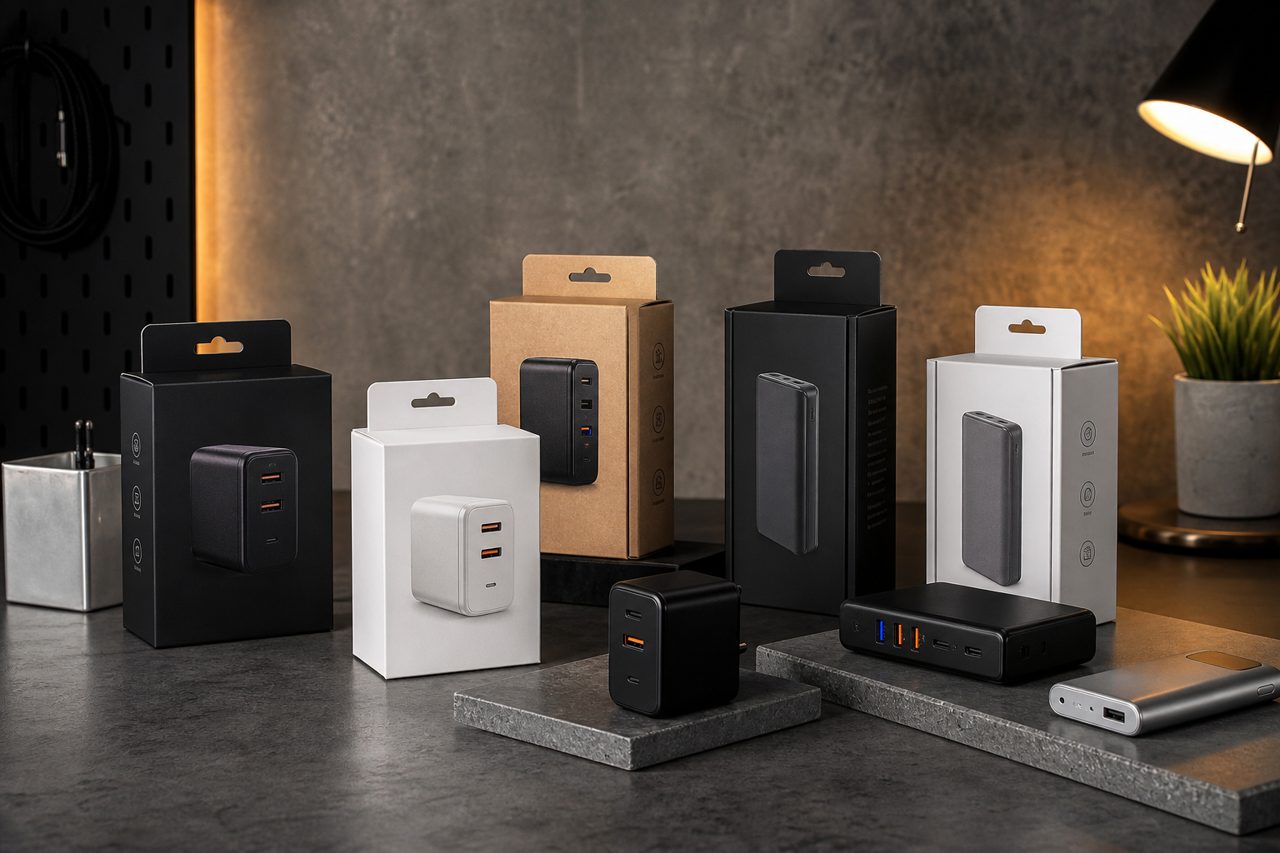
Most charging volume now flows through two very different storefronts, and the channel data makes the split explicit. E-commerce already accounts for roughly 53% of global power bank sales (Grand View Research, 2025), while online captured 35.5% of US mobile accessories sales in 2023 with the share still climbing (Grand View Research). A charger brand therefore lives in both worlds: peg hooks in retail and search results everywhere else. The same carton has to win in both, and the brands that treat packaging as a spec sheet rather than an afterthought are the ones that manage it.
What shelf packaging must do
Retail is a glance economy. A shopper scans a peg wall at arm's length and decides in seconds, which turns the box face into a poster with one job: communicate the product class and the reason to buy it. The hierarchy that works:
- Wattage, largest. The number is the category shorthand; make it readable from two meters.
- Port layout, second. A simple diagram of the ports answers the second question without text.
- One claim line. Size, heat or protocol; one line, not five.
- Category color block. A consistent color across the line makes the brand findable on a crowded wall.
Structure matters as much as print. A hanging tab, commonly a Euro slot, is what makes a charger box work on peg hooks; a flat-bottomed box that only stands on shelves limits the product to counter space a buyer may never get. Window cutouts show the actual housing and finish, which lifts perceived value at the cost of protection and print area; most charger brands compensate with a printed housing image at actual scale.
What marketplace packaging must do
Online, the same box face becomes the listing thumbnail, so shelf legibility converts directly into search-result legibility. Busy layouts that look rich on a shelf turn to noise at thumbnail size; the wattage-first hierarchy survives shrinking. The second job is one the shelf never asks for: survival. Marketplace units travel alone through parcel networks, so the pack has to protect the product through drops and compression without inflating dimensional weight.
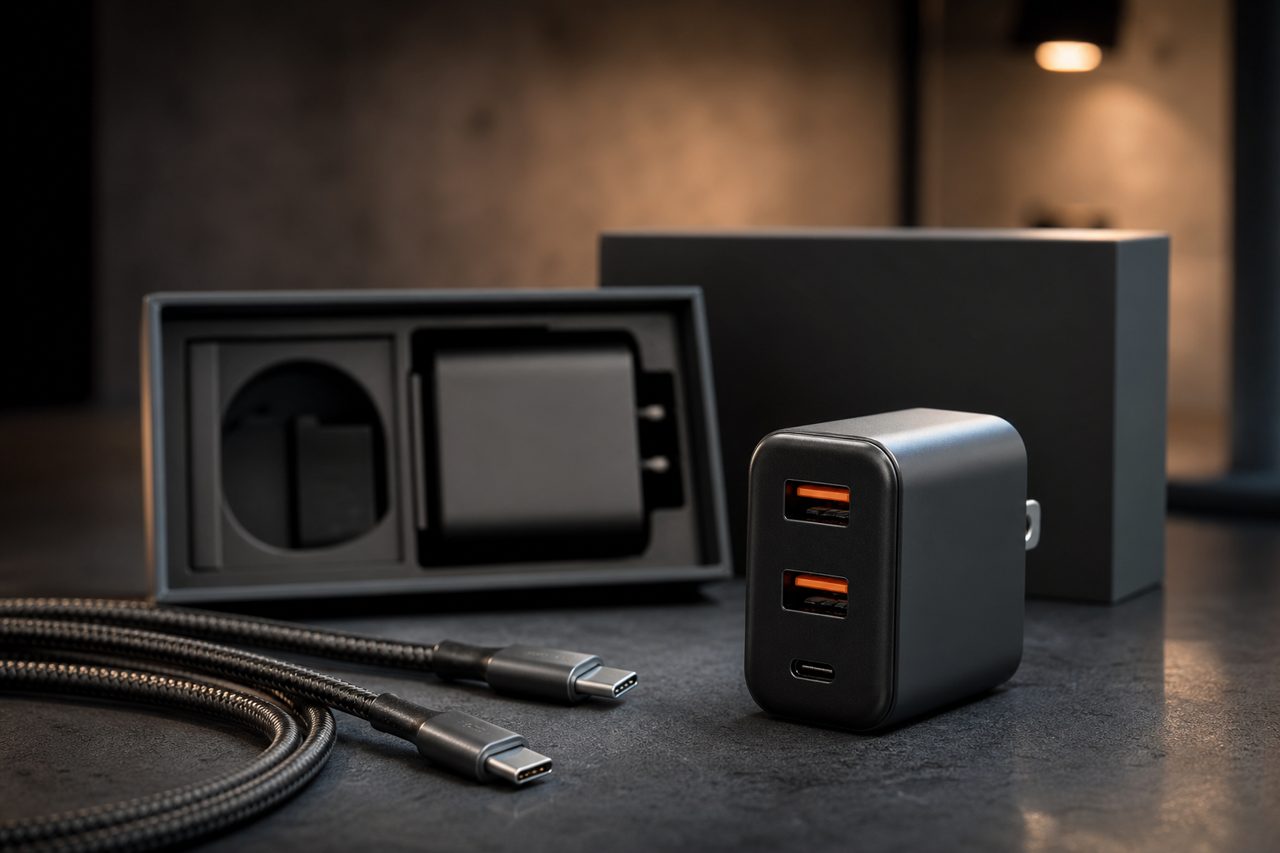
The third job happens inside the box. An insert card is the cheapest after-sales channel a brand owns:
- Setup steps in pictures, since the fastest support ticket is the one a picture prevents.
- Warranty terms and the contact route, printed plainly.
- The power-splitting table for multi-port models, so expectations are set before the first review.
Keep inserts within platform rules: an honest thank-you with support information is fine; anything that pressures reviews conditionally is not.
Compliance printing, market by market
Packaging is also the compliance document the customer and the inspector both read. Requirements stack by market, and the practical baseline looks like this:
| Market | Typical packaging expectations | Seller note |
|---|---|---|
| European Union | CE mark, EU responsible-party details, rated specs, charging-characteristics labeling under the common charger rules | The labeling duty applies to chargers marketed with devices since the December 2024 USB-C rules (European Commission) |
| United Kingdom | UKCA marking path, same information architecture as CE | Kept separate from CE in documentation after Brexit |
| United States | FCC compliance reference, California Prop 65 warning where applicable | Marketplace forms commonly ask for both |
| Japan | PSE mark for regulated electrical items | Confirm the mark's scope covers the exact model |
| South Korea | KC mark for certified products | Match the printed model name to the certificate |
| Universal | Rated input/output, port layout, safety warnings, model identifier | The layer every market reuses |
Two disciplines keep this layer safe. Print only marks the SKU actually holds; a certificate and a box face are verifiable against each other, and mismatches are expensive at customs and in listings alike. And treat the table above as a planning baseline to confirm with your compliance partner before printing, since labeling rules are updated periodically.
The customization ladder
Packaging scales in steps, and the steps mirror the sourcing ladder:
- Stock, from 1 piece. Neutral box, correct compliance marks, no branding. This is the dropshipping stage: sell the product, learn the niche.
- Light customization, 500 pieces per SKU. Logo printing and a custom color box on an existing format. Sampling 5-7 days, volume 12-15 days. This is where a catalog starts looking like a brand.
- Full OEM, 1,000 pieces per SKU. Custom box structure, inserts, and a housing to match. Structural changes from 3,000 pieces. This is where packaging becomes a moat.
The preparation list for a light-custom run is short but specific: logo in vector format, Pantone or CMYK references, the dieline template from the supplier, barcode and model numbering, and the compliance file for every mark the box will carry. Buyers who arrive with these five items move from briefing to printed sample in one round instead of three.
Before the print run, order one blank structural sample. A dieline that folds correctly on screen can hide a tab that blocks the hanging slot or an insert that rattles; a single unprinted sample catches both for the cost of postage. Approve structure first, then color, then compliance placement, in that order, and the printed run becomes a formality rather than a gamble.
Packaging combos that sell
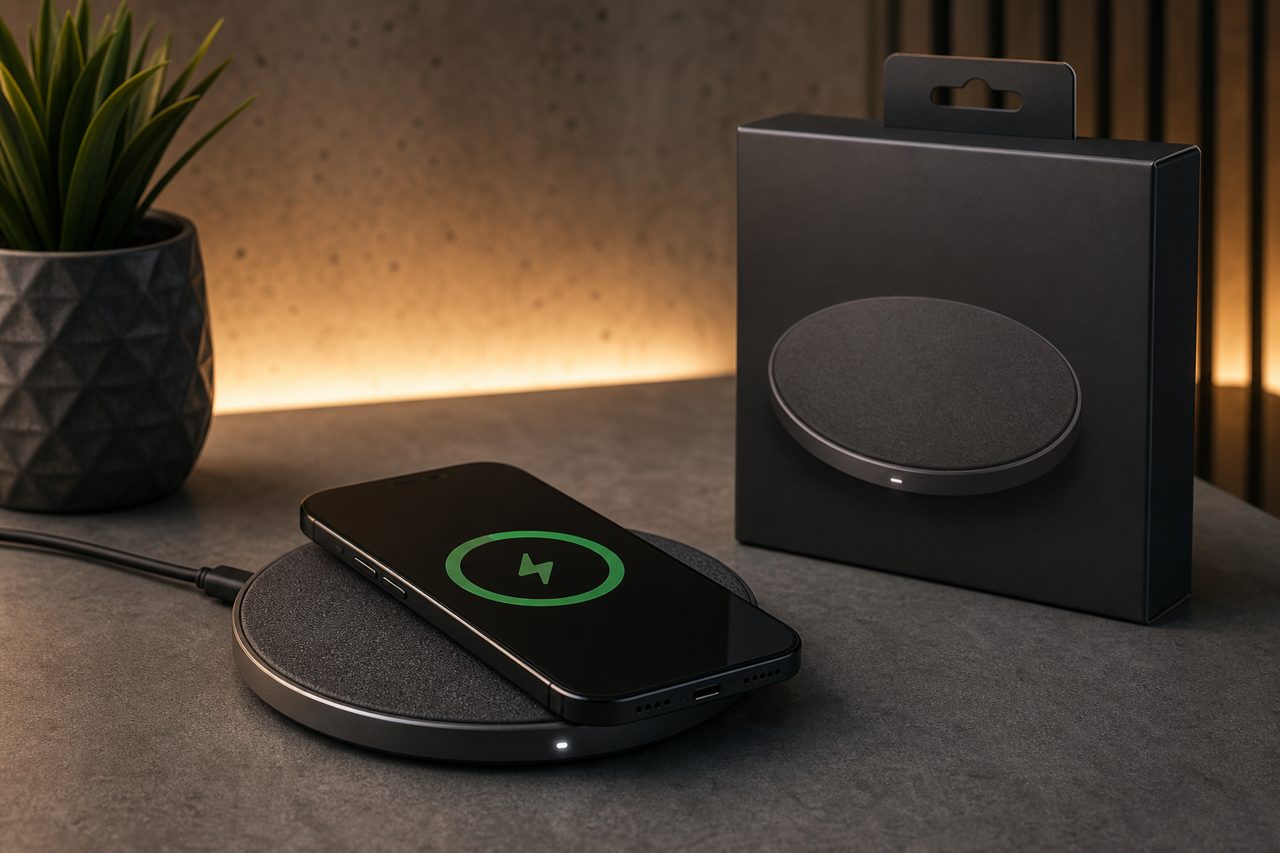
Packaging is also where bundles become real products rather than listing hacks:
- Charger plus cable co-pack. The most common pairing; the cable completes the charging chain and preempts the compatibility complaint.
- Travel pouch kit. Charger, power bank and cable in a zip pouch; the pouch is the perceived-value hero and needs the best material of the set.
- Desk station kit. Multi-port charger plus short cables in a gift-weight box; strong in Q4 and corporate gifting.
Bundle packaging follows one rule: every component inside gets named and specified on the box, because unnamed components read as filler. The cable-side equivalent of these decisions is covered in the cable packaging guide.
From spec to shelf
Every option above, from a hanging-tab color box to a multi-component kit, runs through the same production logic: light customization from 500 pieces per SKU, full OEM from 1,000, with sampling in 5-7 days for packaging and logo work. Start from the stock models on the charging category page, validate demand through dropshipping, then move to the customization path described on the OEM/ODM page. Packaging is the cheapest brand asset a charging line will ever produce; spec it with the same care as the charger inside.
FAQ
What is the MOQ for custom charger packaging?
Logo printing and a custom color box start at 500 pieces per SKU, with sampling in 5-7 days and volume in 12-15 days. Structural packaging changes such as custom inserts or new box formats belong to full OEM, starting at 1,000 pieces per SKU.
What must appear on charger packaging sold in the EU?
At minimum the CE mark, EU responsible-party details, rated specs, and the charging-characteristics labeling required under the common charger rules in force since December 2024. Confirm the current labeling scope with your compliance partner before printing.
Does packaging really matter for marketplace sales?
Twice over: the box face becomes the listing thumbnail, so shelf legibility converts into search legibility, and the box is the shipping armor for parcels that travel alone. Packaging that survives the network protects both the product and the review score.