Retail-Ready Cable Packaging: Hanging, boxed or Eco
The same cable in three different packages reads as three different products at three different prices. Packaging is not the last step of a cable project; it is the pricing decision made visible. This guide compares the three working structures, gives a ready list for each channel, and shows the cheapest path to putting your own box on a shelf.
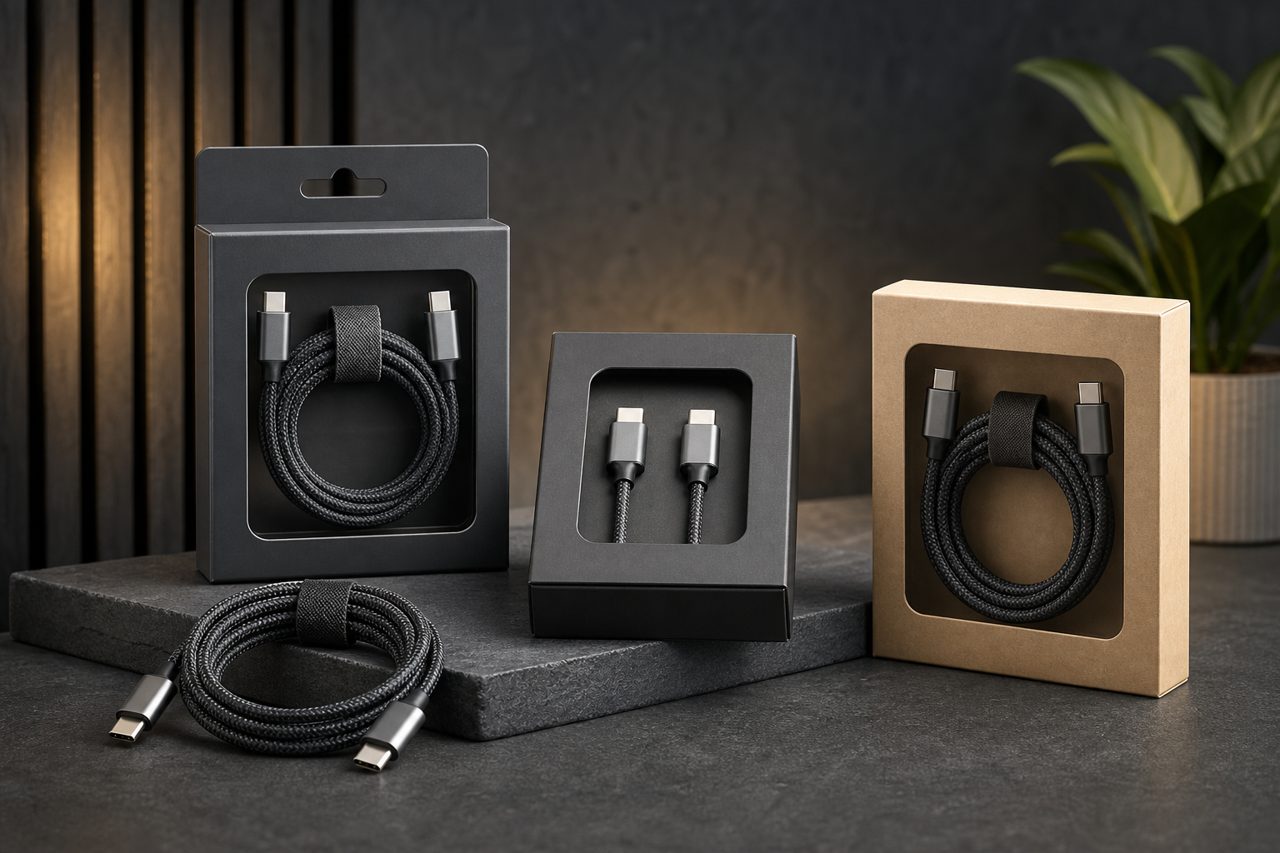
Cable packaging decisions start from the channel, because the same physical product sells in places with opposite rules. Online, the box never meets the customer until the product already convinced them; in a physical aisle, the pack is the entire salesperson. The split is not even: online channels captured 35.5 percent of U.S. mobile accessories sales in 2023 and keep rising (Grand View Research, 2023), which means most sellers need a pack that survives a courier and photographs well, while anyone touching retail doors needs a pack that sells at arm's length. Building both from one structure is possible; pretending one structure serves both is not.
Route 1: The hanging pack
The blister or folding-carton pack with a euro slot is the workhorse of physical accessory retail, and for good reason. It hangs on the peg hooks that dominate mobile shops, convenience stores and automotive aisles, the clear face shows the product, and the printed card behind it carries everything the shelf cannot say. It is also the lowest-cost retail structure per unit, which matters in a category where the pack competes against products a shelf-meter away at half your price.
What the pack must carry to do its job: a euro-slot positioned so the cable hangs straight, a spec panel readable at arm's length with length, wattage and data rate in that order, a scannable barcode zone free of graphics, and room for the market's marks. What it must survive: the peg itself, since a hook that tears out of the card strands the product at the back of the storeroom. A reinforced slot is a fraction of a cent and removes the failure mode entirely.
Route 2: The boxed pack
A window box with an inner tray moves the product up a price tier, and the move is earned rather than printed. The tray holds the cable coiled rather than folded, the window shows the braid instead of describing it, and the box carries a full-color story panel that a blister card cannot fit. This is the structure for gifting seasons, for brand counters, and for any channel where the customer compares your cable to established brands at eye level. It also doubles surprisingly well online: a box that ships as its own protective carton skips the overbox, and the unboxing moment feeds review photos, which no blister does.
The costs are real: higher unit price, more volume in cartons, more freight per unit shipped. The discipline that makes boxed packaging pay is printing run discipline, ordering two or three box variants per line rather than one per SKU, so that a family of cables shares a box architecture and only the spec panel varies.
Route 3: The eco line
The eco structure replaces plastic with paper wherever the design allows: kraft cartons, paper sleeves, molded-fiber trays, and a cable tie instead of a bag. Its commercial function is twofold. In retail, it answers procurement programs that increasingly ask suppliers for packaging reduction commitments before the product is even discussed. Online, it reads as a brand position, and the unboxing of a paper-wrapped cable photographs with a texture that clear plastic never produces. The honest limits belong in the design brief from day one: paper structures protect less against compression than a blister-shell, so the shipping carton and the insert must carry the structural load, and the spec panel has to work in one ink color where the blister version used four.
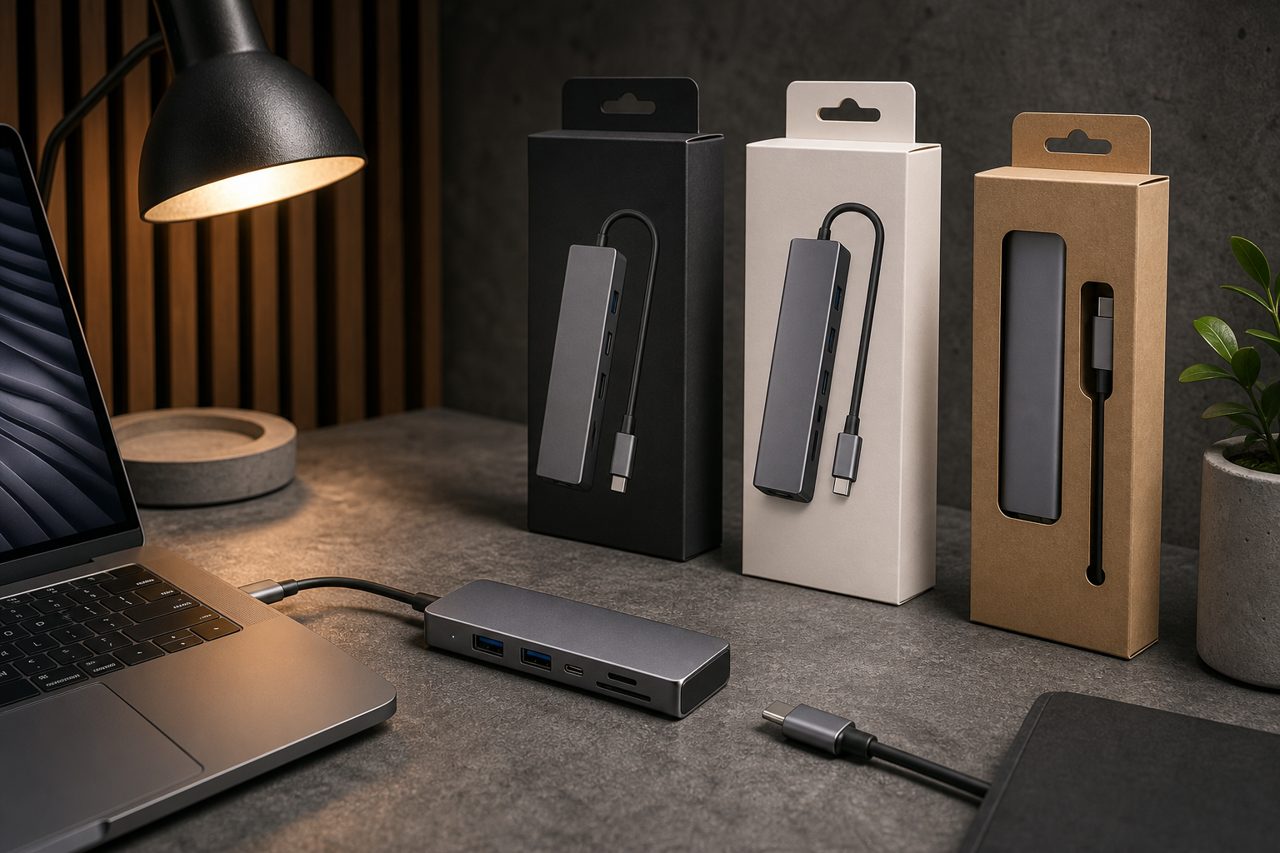
The three routes, compared
| Dimension | Hanging pack | Boxed pack | Eco line |
|---|---|---|---|
| Unit cost | Lowest | Highest | Low to mid |
| Perceived value | Functional | Premium, gifting | Modern, values-led |
| Best channel | Peg-hook retail | Brand counters, gifting, online | Online-first, eco programs |
| In-transit strength | Needs a mailer | Can ship as-is | Needs strong insert and carton |
| Print flexibility | One card face | Full color, story panels | One or two inks |
Three packaging sets, ready to brief
Each channel maps to a specific set of components. Hand these lists to a supplier as briefs rather than describing a mood.
Marketplace starter set
Kraft folding sleeve, paper cable tie, spec panel printed inside and out, insert card with warranty and review invitation, sized so the packed unit posts as a small parcel. This set exists to protect the connector, photograph cleanly on white, and avoid the oversized-box impression that reviews punish. It is the correct default for the first six months of a marketplace brand.
Counter hanging set
Blister shell or carton with window, euro-slot card with reinforced hook, arm's-length spec panel, barcode zone, and a hang-tab that survives humid storage. Built for mobile shops and automotive counters where the pack sells alone. Order the artwork with the market's language first and the export language second.
Brand gift set
Window box, molded or folded tray, magnetic or sleeve closure, full-color story panel, and a die-cut that lets two box sizes share one tray tooling. For gifting seasons, corporate orders and brand counters. This is the set to combine with logo customization once a cable model has proven its channel.
The print content checklist
Whatever the structure, the printed face carries mandatory content, and missing one item is a reprint. Before artwork approval, confirm every line:
- Model or SKU, length, connector types, wattage rating, and data rate, printed in that order of prominence.
- Destination-market marks in their required sizes and positions, plus any recycling or material symbols the structure claims.
- Barcode zone with quiet area intact, and the importer or seller entity where the market requires it.
- Multilingual panel matching the destination market, not a translation of the home market's panel.
- Claims discipline: every wattage and data-rate statement on the box must match the tested product, because packaging claims are the easiest thing for a reviewer to disprove.
From artwork to shelf
Packaging customization is cheaper to start than most sellers assume, because the cable itself stays a stock item. Logo printing and custom retail packaging start at 500 pieces per SKU, with packaging samples in 5 to 7 days and bulk in 12 to 15 days after approval, so a branded pack trails the assortment decision by one sampling cycle rather than blocking it. The staged sequence that works: validate the cable model through dropshipping, commission packaging for the winner through the OEM/ODM process, and keep the loser SKUs in plain packs that still sell. Browse the cables and hubs lineup to pick the models worth a box of their own.
FAQ
Which cable packaging works best for marketplace sellers?
A flat paper-based mailer system: a kraft or folding-carton sleeve around a cable tie, with the spec panel printed inside and out. It protects the connector in transit, photographs cleanly for the listing, carries no retail hook that adds dead volume, and avoids the oversized-box impression that reviews punish.
When is a hanging blister pack the right choice?
When the cable sells in a physical counter channel, mobile shops, convenience, automotive, where peg hooks dominate and the pack must sell at arm's length. The blister shows the product, the euro-slot hangs it, and the printed card carries the spec panel. It is the lowest-cost retail structure and the least suited to gifting.
What is the MOQ for custom cable packaging?
Logo printing and custom retail packaging start at 500 pieces per SKU, with samples in 5 to 7 days and bulk in 12 to 15 days after approval. The cable itself remains a stock item, so the packaging decision can trail the assortment decision by one sampling cycle without holding up launch.