65W vs 100W vs 140W: Which Charger Ratings Sell Best
Wattage is the loudest number on a charger box, and the easiest one to get wrong as a buyer. This comparison maps 65W, 100W and 140W against the devices they actually serve, then turns the map into an assortment ladder you can stock with confidence.
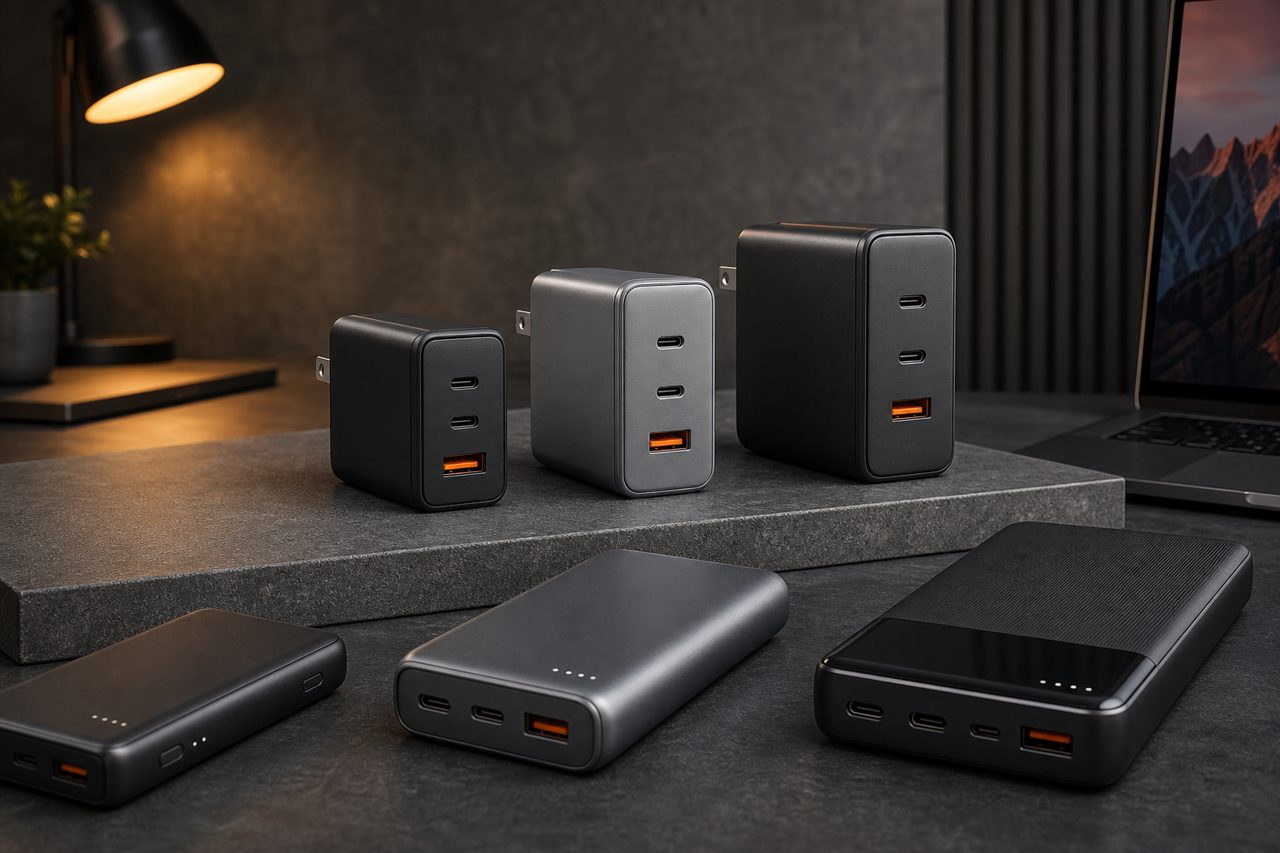
Walk down any marketplace listing page and wattage reads like a scoreboard: more is presumed better, higher is presumed premium. Resellers who take that framing at face value tend to overstock the top of the range and discover, quarter by quarter, that mid-wattage models quietly outsell the headline grabbers. The truth is that each wattage class serves a distinct device population, and "which sells best" is really a question about which population your store attracts. The comparison below gives you the mapping, and the strategy follows from it.
One more force makes the wattage decision time-sensitive. With the EU's common USB-C charger rule already in force for phones and tablets, and laptops following from April 2026 (European Commission), charger specifications have become visible, comparable purchase criteria across whole categories rather than background trivia. Buyers who read wattage tables are no longer hobbyists; they are increasingly your entire market.
What the wattage label actually means
A charger's wattage is a maximum capability, not a constant output. Under USB Power Delivery, the charger advertises a set of voltage and current profiles; the device requests one; the delivered wattage is the product of the negotiated pair. The three ratings in this comparison correspond to well-defined engineering points: 65W is typically 20V at 3.25A, 100W tops the standard range at 20V and 5A, and 140W enters the extended range at 28V and 5A - the first EPR tier, which also demands an EPR-rated cable.
Two consequences matter commercially. First, per-port ratings differ from total ratings on multi-port models, and the split behavior under simultaneous load is where vague listings hide. Second, the wattage a customer experiences is capped by their device: a 140W brick charges a phone no faster than the phone's own ceiling. The negotiation mechanics are covered in detail in our PD 3.1 vs PD 3.0 comparison.
65W: the volume anchor
Sixty-five watts occupies the widest intersection of the market. It fast-charges effectively every phone at that phone's maximum rate, powers tablets, and charges compact and mid-size laptops designed around USB-C input - which describes most machines sold in recent years. Because 65W sits inside the standard power range, it needs no special cable, and GaN design compresses it into the smallest bodies in the category, which is where the size story photographs best.
Retail dynamics reinforce the fit. The price point sits where impulse and considered purchases overlap, the audience spans students through office workers, and replacement demand is steady because 65W chargers travel and travel chargers get lost. For most assortments, this is the SKU that pays the rent, and it is where suppliers compete hardest on size, finish and plug options.
Within the class, two shapes cover most demand: the compact single-port unit for a bag, and the dual-port version for a nightstand or a minimal desk. A 65W pair with different form factors lets one store serve two buying situations without asking customers to understand a new specification - the wattage stays constant, the scenario changes.
100W: the step-up
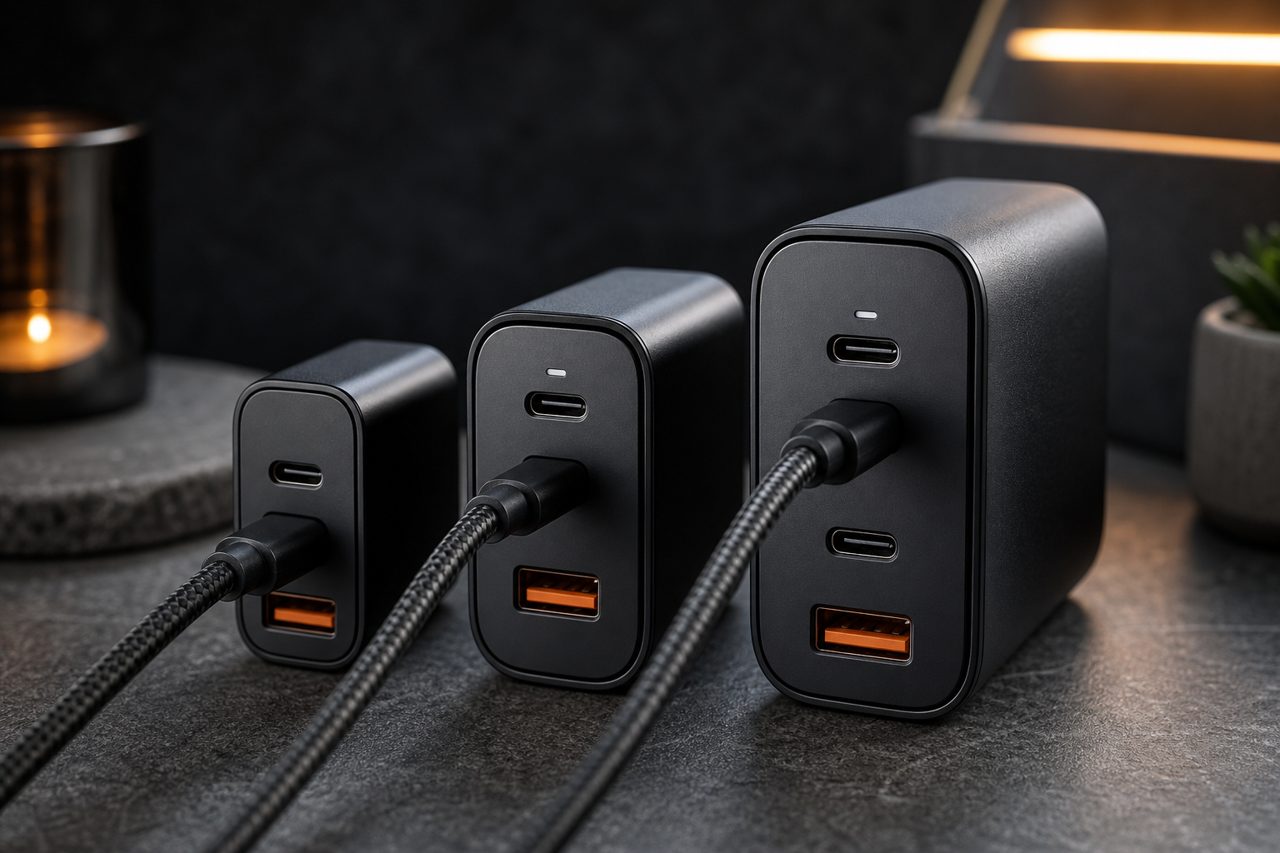
One hundred watts marks the top of the standard range, and its audience is defined by a single scenario: full-size laptops and desks with several devices at once. A 100W unit charges performance-leaning machines at their sustained draw, and in multi-port form it becomes the heart of a one-charger desk - laptop, phone and headphones negotiating their shares automatically. The multi-port form factor is also where the category's growth concentrates; the GaN charger market is projected to grow from USD 1.06 billion in 2024 to USD 9.75 billion by 2034 (Precedence Research), driven substantially by exactly these higher-wattage, multi-device products.
Commercially, 100W supports a higher price point without leaving the mainstream: buyers who research for a moment recognize that this rating covers their next laptop, not just their current phone. Returns risk concentrates in one place - total-versus-per-port confusion - so the split table on the box is not fine print, it is returns prevention.
140W: the halo
One hundred forty watts serves the narrowest audience and plays a distinct commercial role. Its natural customers run performance laptops that draw more than the standard range allows, and reaching them requires the 28V EPR tier with its EPR-rated cable - which is why genuine 140W products ship with a specific cable and say so on the box. Production quality is table stakes here: the audience is technical, reads spec sheets, and writes detailed reviews.
Stock depth should match the role. A halo SKU turns more slowly by design, so shallow inventory and firm pricing serve it better than discounting; its job in the catalog is to define the ceiling and lend credibility to the rungs below, not to win a volume contest.
Stock 140W for positioning as much as for volume. It anchors the top of a wattage ladder, gives the brand a technical ceiling, and raises the perceived capability of the 65W and 100W models beside it. As EU rules extend the common USB-C charging requirement to laptops from April 2026 (European Commission), the addressable audience for high-wattage USB-C charging widens another notch.
The three ratings side by side
| Dimension | 65W | 100W | 140W |
|---|---|---|---|
| Typical PD profile | 20V / 3.25A (SPR) | 20V / 5A (SPR ceiling) | 28V / 5A (EPR) |
| Cable requirement | Standard 5A e-marked | Standard 5A e-marked | EPR-rated cable (50V/5A) |
| Devices served | Phones, tablets, compact laptops | Full-size laptops, multi-device desks | Performance laptops, pro desks |
| Audience width | Broadest | Mainstream professional | Narrow, technical |
| Price tier | Volume sweet spot | Mid-to-premium | Premium |
| Role in assortment | Volume anchor | Step-up and desk hub | Halo and ceiling |
Building the wattage ladder
The comparison translates into a simple structure. Lead with one or two 65W models - single port for mobility, dual port for desks - because they convert across the widest base. Add a 100W multi-port unit as the step-up for buyers with laptops and more than one device. Cap the range with one 140W model that signals technical seriousness. Three to four SKUs cover the entire decision space without fragmenting choice.
Three details keep the ladder honest. State per-port power and the split behavior on every multi-port box. Include a cable that matches each charger's rating, and sell spares against the same spec. And keep the claim language inside what the negotiation actually delivers, because the technical audience that buys high wattage is the same audience that returns products whose claims outrun their labels.
Price discipline completes the structure. Each rung should occupy a clearly separated band, with the step from 65W to 100W justified by a visible difference - extra ports, a bigger display of capability - rather than a vague promise of speed. When the bands overlap, customers default to the cheapest rung and the ladder collapses into a single price fight.
Sourcing the ladder
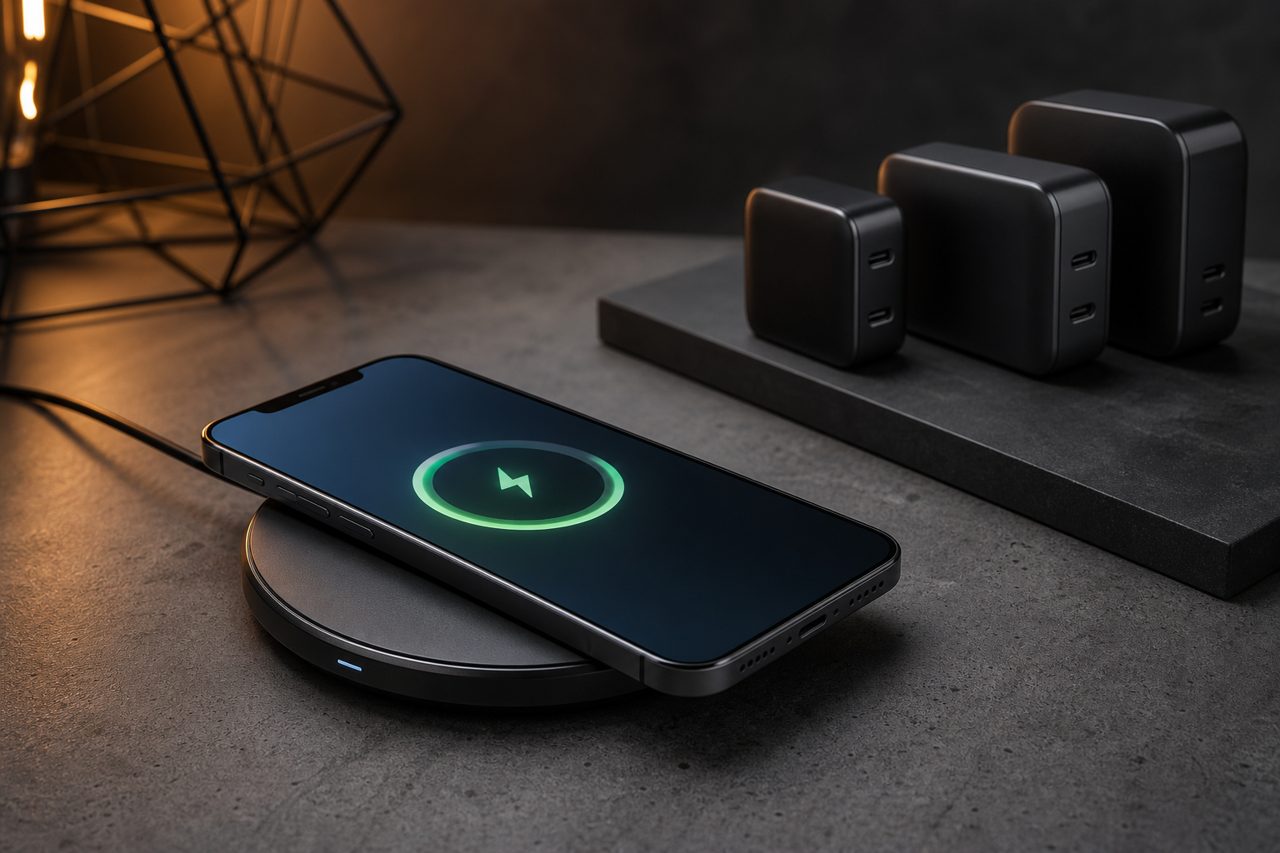
All three wattage classes follow the same sourcing path. Stock models ship from one piece for dropshipping validation, so the ladder can be tested before inventory is committed. Logo and retail-box customization starts at 500 pieces per SKU with 5-7 day sampling; a custom housing starts at 1,000 pieces with 7-12 day sampling, and structural changes from 3,000. The charging category lists current 65W-140W models with documented negotiation profiles, and the OEM/ODM process covers branding across the full ladder - many buyers launch the 65W anchor first and add the rungs as data confirms demand.
FAQ
Which wattage should a new store stock first?
For most audiences, 65W. It fast-charges phones at full speed, charges compact laptops, comes in the smallest bodies and serves the broadest base. Add a 100W multi-port model and a 140W halo unit once the base is selling.
Can a 140W charger damage a phone?
No, on a properly designed charger. PD is negotiated: the phone requests what it accepts and the charger delivers only the agreed profile. A phone on a 140W unit draws what it would draw on any charger.
Is 100W enough to charge a laptop?
For most compact and mid-size laptops, yes - many are designed around USB-C charging at or below 100W. Larger performance machines may draw more under load, which is where 140W EPR models apply. Check the laptop's rated input.