The Vlogger's Travel Kit: Packing Light Without Skipping Shots
Travel creators make one decision the rest of us never see: every gram in the bag has to earn its place against the shots it buys. That discipline is a product opportunity. A travel vlogging kit that answers it honestly — small, complete, one pouch — sells to the most motivated segment in creator gear, and this article lays out what goes in, what ships differently, and how to list it.
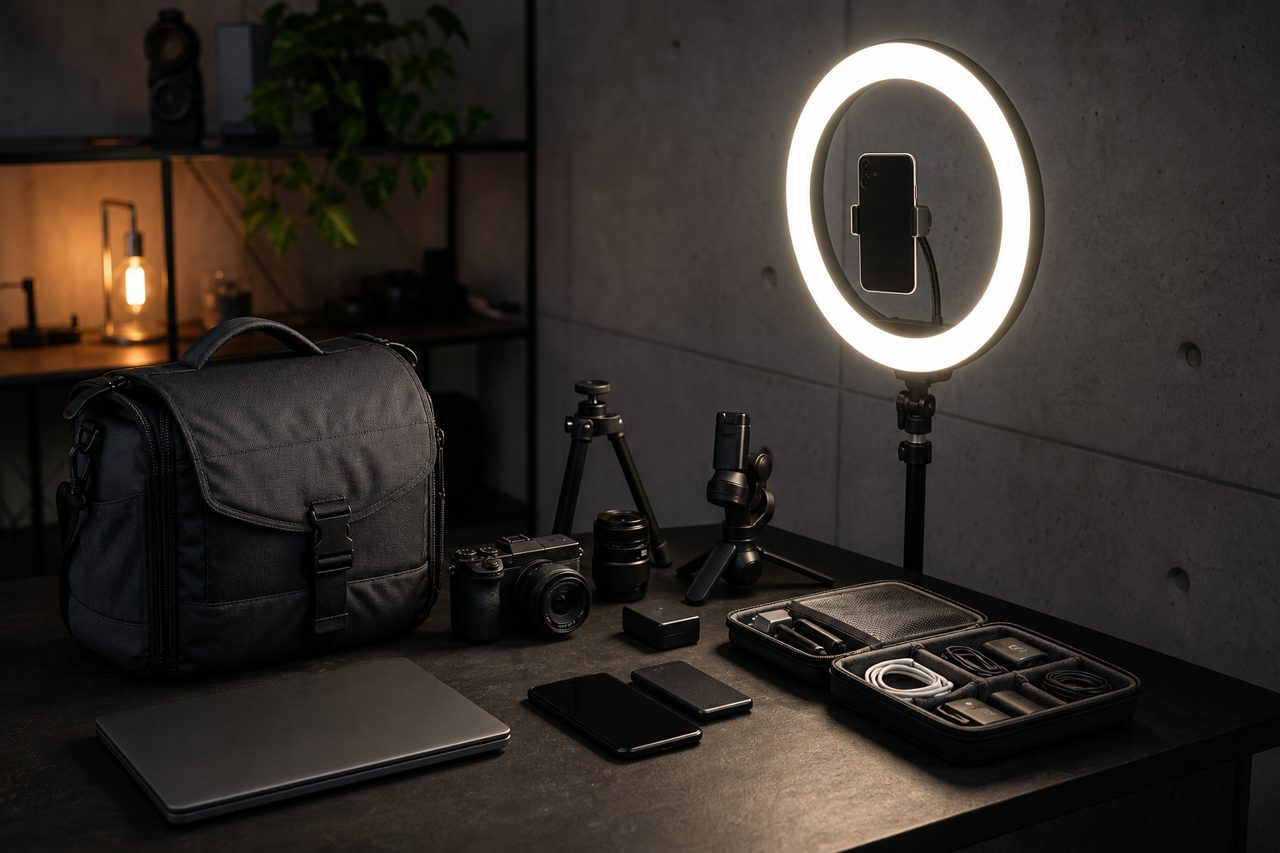
The desk setup market sells comfort; the travel kit market sells capability under constraint. Travel vloggers shoot on phones or compact cameras, in lighting they do not control, powered by whatever they carried. The failure mode is not poor image quality — it is the shot skipped because assembling the rig took two minutes and the moment lasted five seconds. Buyers in this segment have usually already made that mistake once with loose components, which is precisely why they will pay for a kit that solves it.
The segment rewards specialization. A kit built for everyone fits no one's bag, while a kit built for one trip type slides straight into the buyer's plan and defends its price. That is why composition should be treated as the product itself: the parts inside are available anywhere as commodity items, but the selection, the pouch and the discipline encoded into the setup sheet are the actual product a buyer cannot assemble from a marketplace search.
Who buys travel kits
- Travel vloggers and lifestyle creators. The core segment; they know exactly which shots they missed last trip and shop against that memory.
- Casual travelers upgrading their phone footage. A much larger pool: family trips, city breaks, one good camera bag. They buy the outcome "better videos than last year" and need the listing to promise it simply.
- Gift buyers. A packed pouch is a legible gift with a visible before-and-after, which makes it a seasonal performer around travel-heavy holidays.
Note what unites all three: they buy before a specific trip, on a deadline. Search behavior spikes ahead of travel seasons and gifting holidays, so the inventory calendar matters more here than in the desk category — a kit that sells out in the spring rush watches its keywords belong to competitors for the rest of the year.
The kit list: six items that earn their weight
Everything in the pouch should pass one test: name the shots it unlocks, or leave it home. The core list:
| Item | Why it earns its weight | Buyer note |
|---|---|---|
| Grip-style pocket tripod | Handle, desktop stand and timed-shot support in one piece; the most-used item in the pouch | State the phone-width clamp range; this is a fit-driven purchase |
| Phone gimbal or compact camera | The capture core; stabilizer for walking shots or a dedicated compact body | If the kit includes a gimbal, note charge-while-operating behavior in the listing |
| Mini LED light | Fixes backlit faces and dim interiors, the two most common travel-footage complaints | Adjustable color temperature earns its place; fixed-warm panels do not |
| Clip-on wireless microphone | Viewers forgive mediocre frames; they do not forgive inaudible speech on windy streets | Include the windscreen in the box list explicitly |
| Power bank | Everything in the kit charges from it; the true runtime of the whole kit, not one device | Battery shipping rules apply — see below |
| Short cables, one pouch | Short cables vanish into a pocket; long ones strangle a packed bag | One pouch for everything; loose items are the ones lost |
The table doubles as the listing's box list. Anything beyond these six — extra mounts, second lenses, full-size stands — belongs in a car kit or a studio kit, not in the pouch, and padding a travel kit with them is the fastest way to teach the customer that your weight judgment cannot be trusted.
Power and the shipping reality
The power bank is the kit's quiet center of gravity, commercially and logistically. Commercially, it defines the kit's real runtime: a vlogger's day is bounded by the bank's capacity as much as by any device's battery. Logistically, it changes how the kit ships. A kit containing a power bank is a battery-containing shipment, which moves under IATA rules — UN38.3-tested cells, PI967-compliant packing and labeling — on battery-capable lanes that typically run 8-18 days door to door, against 7-15 days for standard goods. The practical consequences for a seller: set the kit's delivery promise by its battery item, not its fastest component, and source from a supplier whose battery channels are a standing capability rather than an improvisation. Kits sold without the power bank sidestep the constraint entirely, which is a legitimate variant — "kit minus power, bring your own bank" — for markets where battery logistics are difficult.
Usage discipline the kit should assume
The best travel kits bake habits into their design. Overnight charging is the core one: a pouch where every device charges from one bank on one nightstand, with short cables, means the kit leaves the hotel at full capacity every morning. The second habit is offload discipline: enough pouch space or a folder routine that footage leaves the phone nightly, because a full phone is the quietest way a travel vlog dies. Listings and setup sheets that state these two habits — charge everything nightly, offload nightly — position the kit as a system rather than a pile of accessories, and the buyer who follows them gets the footage the listing promised.
The pouch itself carries the discipline. Elastic loops sized to each item mean one glance confirms completeness, and a labeled slot that stays empty is a louder reminder than any line of listing copy. Kits designed this way earn a specific review genre — the buyer who filmed the whole trip and never lost a piece — and that is exactly the review a travel listing needs to keep selling.
Listing and bundle advice
- Sell the trip, not the parts. A city-break kit and an outdoor kit can share components but deserve different listings; buyers recognize themselves in trips, not in SKU lists.
- Photograph the packed layout from above. Buyers judge size against their own bag; an honest top-down shot of the pouch contents pre-empts the "smaller than expected" return reason.
- Publish weights where possible. Even approximate per-item weights signal that the kit takes packing discipline seriously.
- State what the kit is not. No full-size camera support, no spare batteries included, gimbal sized for phones. Negative space in the listing is dispute prevention.
- Describe compatibility in plain language. Which phones the clamp takes, which connector the mic uses, whether a USB-C adapter is in the pouch — factual wording, no borrowed brand names.
- Bundle the consumables. A spare windscreen and a second short cable cost little and attach naturally to the first kit rather than as a second order the buyer never makes.
The sourcing bottom line
The travel kit is a composition exercise: six honest items, one pouch, one delivery promise set by the battery. Validate the first kits one piece at a time through dropshipping — stock dispatches within 48 hours, and the battery channel covers power-bank variants compliantly. Branded pouches and boxes start at 500 pieces per kit with 5-7-day sampling for light customization, and full OEM at 1,000 pieces; the customization paths are on the OEM/ODM page, and the component families sit on the creator gear category page.
FAQ
What belongs in a packing-light vlogging kit?
Six items: a grip-style pocket tripod, a phone gimbal or compact camera, a mini LED light with adjustable color temperature, a clip-on wireless microphone, a power bank, and short cables in one pouch. Each item must justify its weight against the shots it unlocks, and the whole kit must assemble in seconds — the kit that takes two minutes is the one left in the hotel.
Can a travel kit with a power bank be dropshipped internationally?
Yes, on a compliant channel. A power bank makes the kit a battery-containing shipment moving under IATA rules — UN38.3-tested cells, PI967 packing — on lanes that typically run 8-18 days, versus 7-15 for standard goods. Set the kit's delivery promise by its battery item, or offer a kit-minus-power variant for difficult markets.
How should a travel kit listing be positioned?
Lead with the trip type, not the parts. Show a top-down photo of the packed layout, publish the exact box list with approximate weights, and state what the kit is not — no full-size camera support, no spare batteries. Plain-language compatibility beats borrowed brand names, and bundling the consumables attaches them to the first order.