TWS Latency for Gaming: What 60ms Actually Means
Low latency is the make-or-break specification in gaming earbuds, and listing pages quote it as a single number - 60 ms, 45 ms, lower still. This guide explains where that delay physically comes from, what typical ranges look like by connection type, and how a B2B buyer can verify a low-latency claim in twenty minutes before committing shelf space.
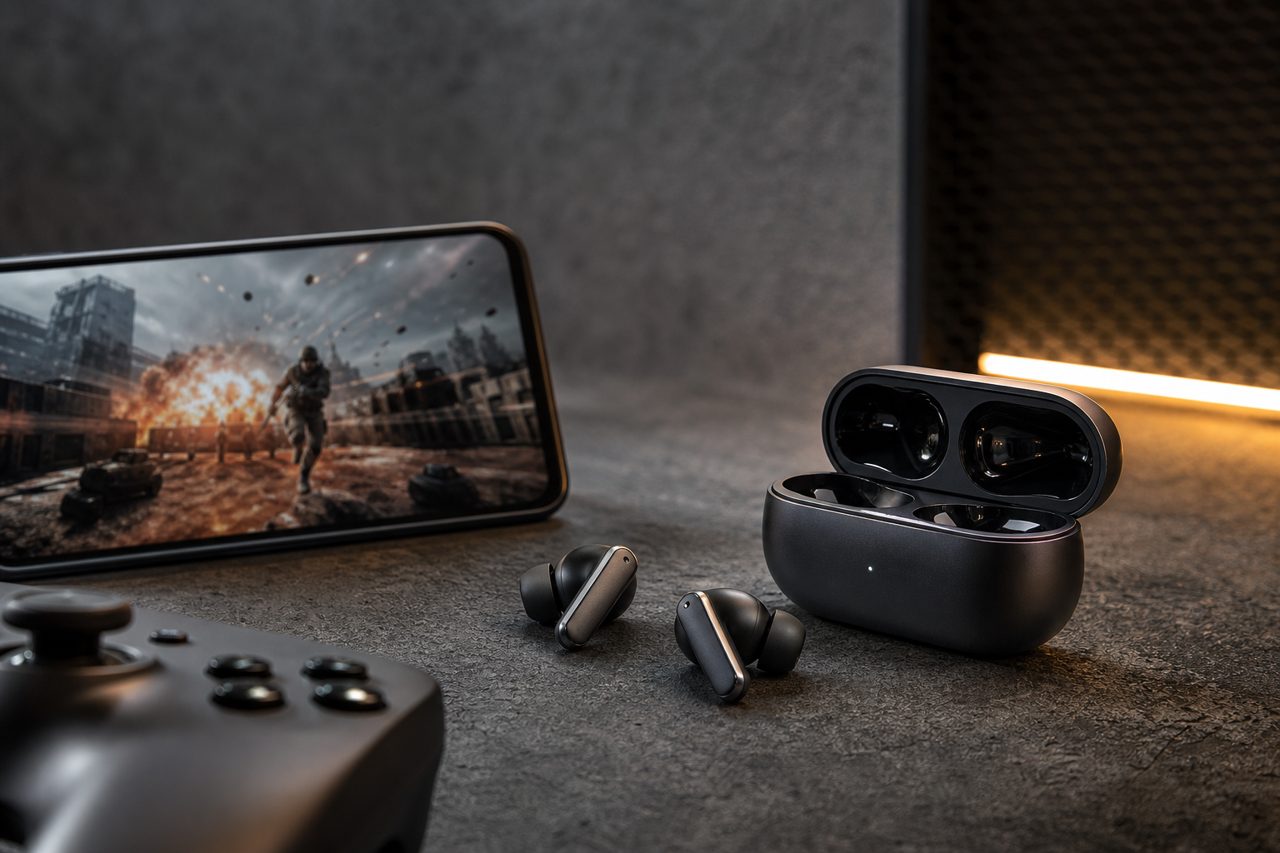
True wireless earbuds keep growing as a category - global sales volume rose 7 percent in 2024 as the market matured into a replacement cycle (Counterpoint Research, 2024) - and gaming has become one of the most reliable sub-segments inside that growth. Gaming-oriented TWS models carry their own spec language, and no term on the box is quoted more often than latency. The number is a promise about a pipeline the buyer never sees: encoding on the phone, radio transport, decoding and processing in the earbud. Understanding that pipeline is what separates a defensible listing claim from a complaint magnet.
Where the milliseconds come from
Audio delay is additive across five stages, and every wireless product trades among them:
- Encoding. The source device compresses audio into the negotiated codec. Encoding adds a small delay, but the larger cost is the buffer the codec needs before it can release a frame of audio.
- Transport. Bluetooth moves data in fixed timing slots. The interval between slots, and how many retransmissions the link allows, sets a floor no firmware can beat.
- Decoding. The earbud reconstructs the audio stream, again needing buffered data to work with.
- Processing. Equalizer curves, ANC mixing, spatial effects and game-mode DSP each add processing time, usually small but never zero.
- Output buffering. The final buffer before the amplifier smooths jitter so playback never stutters. This is the stage vendors shrink first in low-latency modes, at the cost of robustness.
Because the stages add up, no single component explains a claim of 60 ms. A product hits that number by shortening buffers, choosing faster codec paths and tightening transport intervals all at once - and each of those choices has a cost somewhere else.
Approximate ranges by connection type
Engineering practice across the industry produces consistent order-of-magnitude ranges. The figures below are approximate and vary with the phone, codec implementation and radio environment, but they are the honest backdrop against which any listing claim should be read.
| Signal path | Typical end-to-end delay | What it means for a buyer |
|---|---|---|
| Wired connection (reference) | Single-digit milliseconds, effectively negligible | The baseline every wireless claim competes against |
| Bluetooth, standard music mode | Commonly in the 150-250 ms range | Why earbuds without a game mode draw complaints in video and gaming use |
| Bluetooth with vendor game mode | Commonly in the 60-130 ms range | The mainstream gaming-style tier; fine for casual and mid-core titles |
| Dedicated 2.4 GHz link with USB-C dongle | Commonly in the 25-60 ms range | The gaming-grade tier; the format competitive players actually buy |
What 60 ms feels like
Some arithmetic frames the number. One frame of 60 fps video lasts about 17 ms, so 60 ms of audio delay leaves sound roughly three and a half frames behind the picture. In dialogue-heavy video, desync of this size is apparent to many viewers once they notice it, which is why even non-gamers return standard-mode earbuds after trying to watch content. In games the cue structure is tighter: a footstep or gunshot that arrives late loses its tactical meaning, and rhythm titles that score the player on timing become genuinely difficult, because the correct input window closes before the sound arrives.
Sensitivity varies by person and by title, and no honest supplier should quote a universal perception threshold as if it were a measured constant. The commercial conclusion is sturdier than the psychophysical one: the market has split into gaming-style products - Bluetooth with a low-latency mode, sold on value - and gaming-grade products built around a dongle link, sold on performance. Your listing must be clear about which one it offers, because the mismatch between expectation and reality is what generates returns in this segment.
How vendors actually reach low latency
- Shrinking buffers. The output and codec buffers give up headroom, which speeds the chain and makes playback more fragile under interference.
- Codec choice. Lower-complexity or proprietary low-latency codec paths reduce encode and decode delay compared with standard music codecs.
- Tighter transport intervals. More frequent, smaller radio packets shorten the transport floor and raise power draw slightly.
- Dedicated dongle links. A USB-C or plug-in dongle lets the earbuds leave the crowded shared band coordination behind and run a purpose-built protocol, which is how the lowest figures are achieved.
- Automatic switching. Better models detect game audio or use in-app toggles, so the mode engages without the user finding a menu.
Every one of these trades costs something: range shortens, battery time drops, or connection robustness suffers in radio-dense rooms. That is precisely why the verification step below matters more than the number on the box.
A twenty-minute check before you list
Latency is measurable without laboratory equipment, and the following routine fits inside half an hour per sample pair:
- Install a rhythm or reflex game that reports timing offset, or a metronome app, as the test signal.
- Pair with two phones on different platforms, since codec paths differ, and note the baseline delay in music mode.
- Toggle game mode and record the change; then disconnect and reconnect to confirm the mode persists instead of silently reverting.
- Play a dialogue-heavy video and note lip-sync at the mode you intend to advertise.
- Walk eight to ten meters away with the phone in a pocket and confirm the low-latency link holds without stutter through two walls.
- Log playback time in game mode against music mode, and put both figures in your listing copy.
Positioning gaming TWS in a catalog
For most sellers the right move is one SKU in each tier rather than five in one. A 60 ms-class Bluetooth model with an honest game mode serves the mass-market tier; a dongle-based model serves buyers who pay for performance. Stock models ship from a single piece through our dropshipping program, with 48-hour dispatch, so both tiers can be validated in real usage before committing capital. Once demand is proven, logo and packaging customization starts at 500 pieces per SKU and full OEM - including custom dongle integration - at 1,000, with sampling in 5-7 and 7-12 days. Every unit contains lithium cells, so replenishment runs on the UN38.3 and IATA PI967 compliant battery channel in 8-18 days. Compare both tiers in the current audio category.
FAQ
Is 60 ms latency good enough for gaming earbuds?
For casual and mid-core titles, a stable 60-80 ms link feels acceptable to most players. Competitive shooters and rhythm games reward the 40 ms class that dedicated dongle links reach. List the product for the tier it actually serves.
Do wired earbuds have zero latency?
Not zero, but effectively negligible - single-digit milliseconds from the analog or USB path. All perceptible delay in wireless audio comes from encoding, buffering and radio transport.
Does game mode reduce sound quality or battery life?
Usually both, slightly. Low-latency modes trade buffering headroom and often codec efficiency for speed, so expect shorter playback time and reduced wireless range while the mode is active.