Inside TWS Charging Cases: Cells, Contacts and Hinge Life
The earbuds get the reviews; the case gets the returns. A charging case is a power bank, a mechanical fixture and a charging protocol packed into the part buyers touch most often - and the part no spec sheet explains. This walkthrough covers the four components that decide case reliability, what to check on samples, and the questions that separate a real case design from a generic housing.
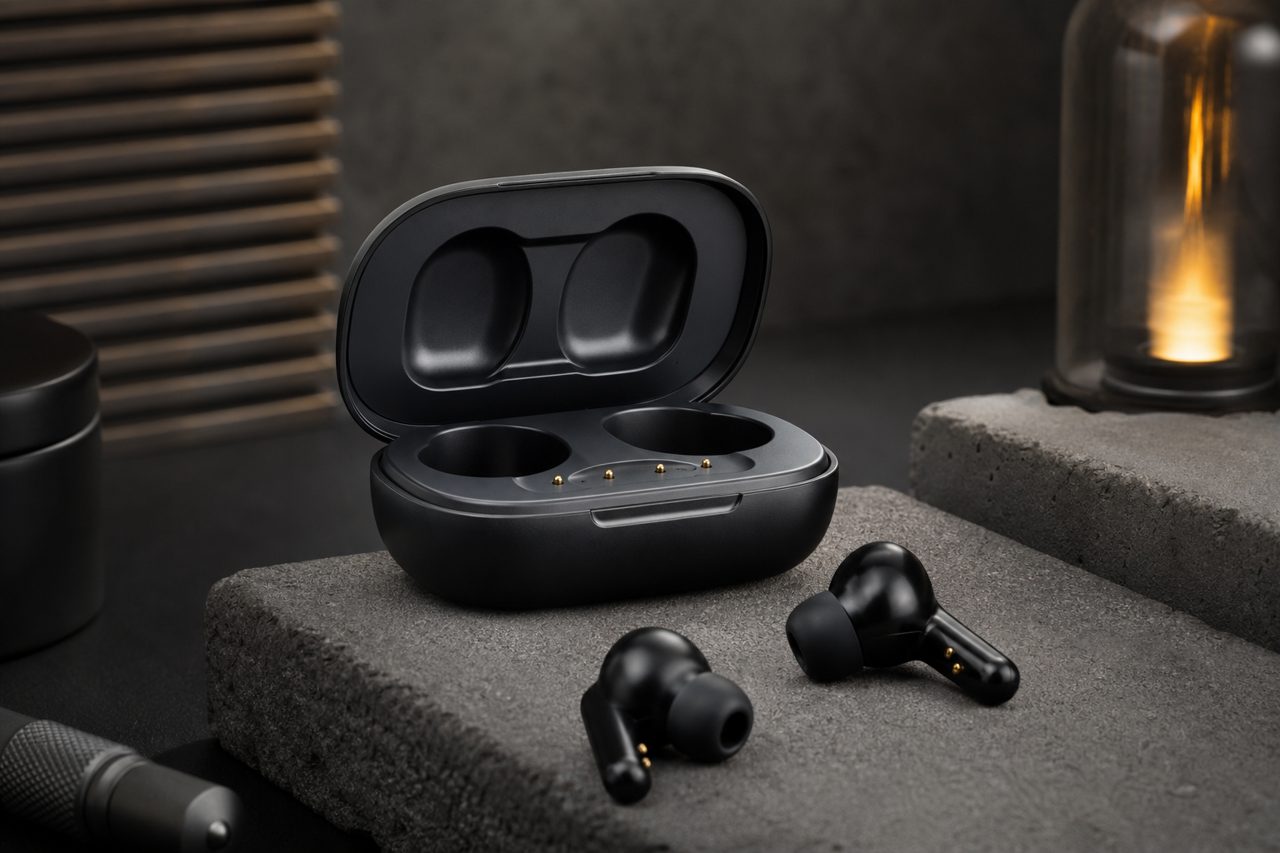
On a bill of materials the case looks minor: a plastic shell, a small cell, a couple of pins. In the returns ledger it is rarely minor. Cases that stop charging one bud, lids that snap, hinges that loosen, contacts that lose connection - all of these read as "the product stopped working" in a review, not as "the case failed." Understanding what is inside lets you interrogate samples with specific questions instead of general trust, and it tells you which of those questions belongs to the factory conversation rather than the listing conversation.
What the case actually is
Three products share one shell. The first is a small power bank: a lithium cell, a protection circuit and a discharge path that pushes current into the buds' contacts. The second is a mechanical fixture: a cavity that seats two small objects precisely enough for pins to align, plus a lid and hinge that survive thousands of open-close motions. The third is a protocol participant: it must cooperate with the buds' charge management rather than simply push current, and it must accept power from ordinary USB-C sources without complaint. A case is therefore judged on three independent axes - electrical, mechanical and protocol - and a sample can pass one axis while failing another, which is why each gets its own check below.
The cell and its protection circuit
The cell is a small lithium-polymer pack sized to the cavity, and long-term safety lives in its protection board: overcharge cutoff, over-discharge cutoff and current limiting. This is also where supplier quality is easiest to distinguish. Ask which cell specification the design uses and whether the protection board is a documented component or an undocumented assumption. The answers cost nothing and reveal how the factory thinks. For logistics, the cell makes the finished product a regulated item for air transport: compliant shipments move on battery-ready channels under the UN38.3 test framework and IATA's PI967 provisions for lithium-ion batteries contained in equipment. A supplier who cannot produce UN38.3 documentation for the cell is not a supplier for the air channel at any price, because the constraint belongs to the airline, not to either company's preference.
Contacts: the smallest part that fails first
Most "one bud stopped charging" stories begin at the contacts. Spring-loaded pogo pins must stay aligned with the buds' pads across thousands of seating cycles, resist corrosion, and keep enough travel to compress against manufacturing tolerance in both the buds and the cavity. On samples the checks are physical and quick: seat the buds fifty times while watching for charging interruptions; check whether the pins sit flush or proud of the cavity floor; inspect plating quality under a loupe. Magnetic latching, where the case pulls the buds into alignment, removes the user-aim requirement and is worth having - but magnets introduce their own tolerance stack, so test seating with the lid closed, not only open, and with a thin phone-style film wrapped around one bud to simulate a slightly off-dimension unit.
Hinge and closure life
The hinge is the case's only true wear part. Owners cycle it several times a day for the life of the product, and a hinge that loosens or cracks reads as product death even when the electronics are healthy. Design quality here is a stated target, not a feel: ask what open-close cycle count the hinge design targets and what evidence exists behind it - cycle-fixture runs, teardowns after testing. On the sample, work the lid through a hundred cycles and watch for play developing at the pivot, changes in latch strength, and any creak from the shell seams. Latch feel is also commercial: a positive, audible click is part of the perceived quality that justifies a higher price tier, and it is cheaper to select for at sampling than to retrofit into a shipping product.
The input port and what regulation requires
The case's own charging port is now a compliance item, not merely a convenience. Since December 28, 2024, the EU has required a common USB-C charging interface on a range of portable devices including earbuds (European Commission) - so a case bound for the European market needs the USB-C input and the labeling discipline that regulation introduced. Beyond compliance, test practical behavior: charge the case from a laptop port and from a wall adapter and confirm it accepts both; confirm charging continues with the buds seated, since most owners treat case and buds as one object they plug in overnight; and confirm the indicator lights mean something a buyer can decode without a manual.
The sample checklist
Take this table into the sample session. Each row takes fifteen minutes or less:
| Component | Bench check | Ask the supplier |
|---|---|---|
| Cell and protection | Full charge through a USB meter; check warmth and input mAh | Which cell specification; is the protection board a documented part |
| Air-freight compliance | Request documents before booking freight | UN38.3 report for the cell; PI967-capable packing and labels |
| Contacts | Fifty seating cycles watching for charge interruption | Pin material and plating; alignment tolerance method |
| Hinge and latch | One hundred open-close cycles; check for pivot play | Design cycle target and cycle-test evidence |
| Input port | Charge from laptop and wall adapter with buds seated | EU USB-C compliance approach and label artwork |
A case that clears every row is a product you can put a claim behind. A case that fails one row is not necessarily rejected - it is negotiated with a specific defect named, which is a far stronger position than "quality feels off."
From checklist to order
Validate at single-piece quantities through the dropshipping program before scaling - 48-hour dispatch means the bench work above starts within days. In-stock models are listed in the audio category with their case specifications. When the case itself must carry your brand - logo on the lid, retail box, custom color - light customization starts at 500 pieces per SKU with sampling in 5-7 days; changes to case structure such as cavity, hinge or cell layout belong to full OEM customization from 1,000 pieces per SKU with sampling in 7-12 days, and structural changes run from 3,000 pieces.
FAQ
Is a faulty charging case a warranty replacement or a repair?
Treat it as a replacement. Case faults - contacts, hinge, cell - are not user-serviceable, and a case that fails in the field usually takes the pair's perceived quality with it. For units damaged in transit, replacements are issued against photo evidence within 30 days of delivery.
Does the EU USB-C rule apply to the case or only to the earbuds?
In practice it applies to the product you ship: true wireless earbuds fall within the scope of the EU common charging requirement, and since the case is the charging entry point, a USB-C input on the case is how the product complies. The requirement has applied since December 28, 2024 (European Commission).
Can we specify a larger cell in the case?
Yes, as an OEM project - changes to cavity, lid or cell layout start at 1,000 pieces per SKU, with structural changes from 3,000. Expect the larger cell to reshape the case and to reopen compliance work, since the new cell needs its own UN38.3 documentation for air freight.