9H Tempered Glass: Hardness, Oleophobia and Reality
"9H" is the most printed and least understood spec in the screen protector category. It is a real measurement with a precise meaning - and almost none of the meanings buyers attach to it. Stores that understand what 9H actually measures can spec better SKUs, write listings that survive reviews, and answer the one-star complaint "it scratched anyway" before it happens.
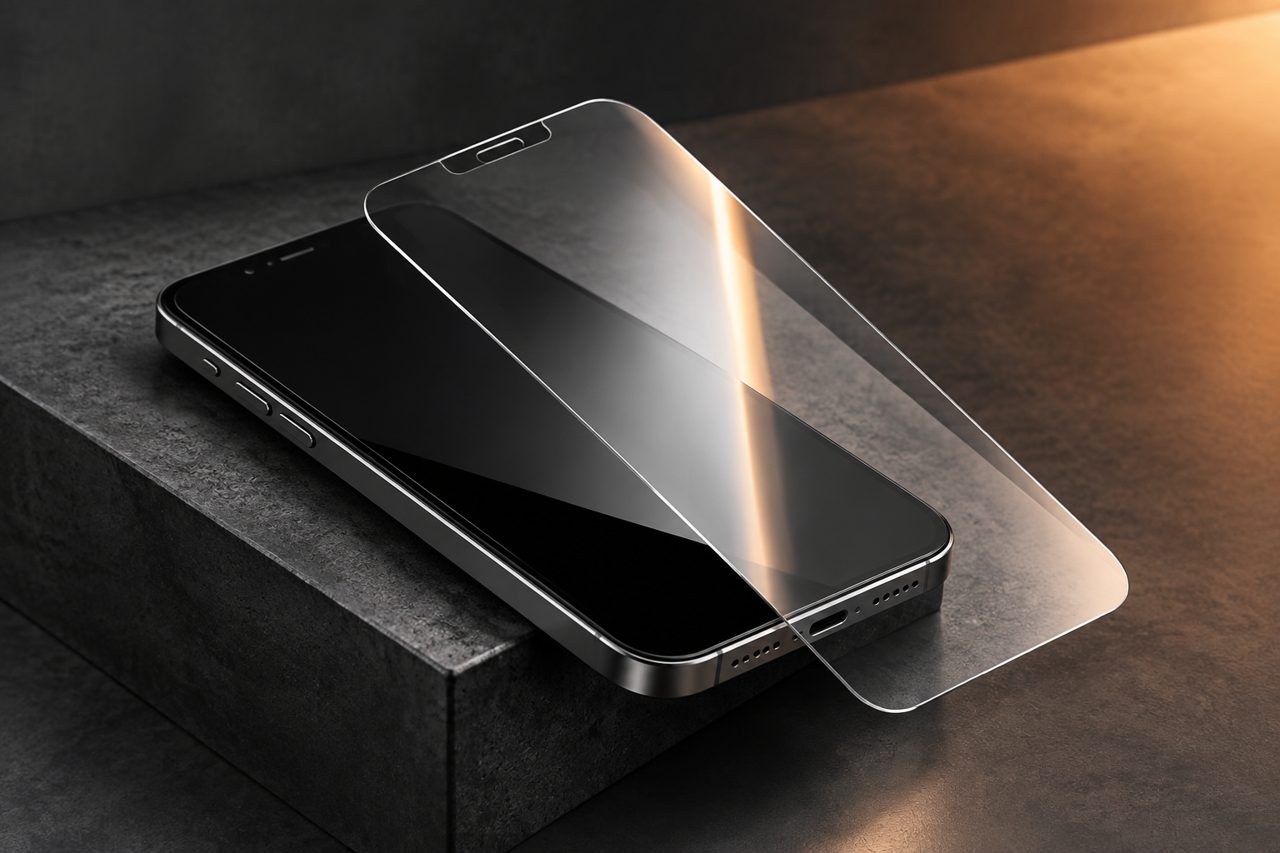
Every tempered glass protector is three products in one: a sheet of strengthened glass, an adhesive system that holds it flat against the screen, and an oleophobic coating that decides how the surface feels under a finger. The 9H mark describes only the first of the three, and only against a particular test. The other two layers decide most of the daily experience - and most of the returns. That is why this article spends more words on coatings and construction than on the famous grade itself, and why the spec checklist at the end barely mentions hardness at all.
Two hardness scales, one marketing shortcut
The 9H grade comes from the pencil hardness scale, the same scale used in the coatings industry: pencils graded from soft to hard are pushed across a surface in a standardized scratch test, and the hardest pencil that does not cut the surface becomes the rating. On that scale, 9H is the top common grade - a surface no pencil in the test cuts. Mineral hardness uses a different scale entirely, the Mohs scale, where common quartz - the main ingredient of pocket grit and beach sand - sits around level 7, and hardened glass sits nearby. The scales do not convert. A 9H pencil rating makes no promise against a quartz particle dragged across the screen under finger pressure, which is exactly the mechanism behind most real-world scratches. This is the single most important fact in the category: the scratches customers complain about come from minerals, and 9H is not a mineral rating.
What 9H does and does not promise
Read honestly, a 9H rating promises resistance to the things a pencil test models: metal contact - keys and coins in the same pocket - and everyday sliding against softer materials. That is a real promise worth a real line in a listing: "resists scratches from daily metal contact." What it does not promise is scratch-proof glass, shatter-proof glass, or protection for the phone's original screen against drops - edge impacts defeat any flat sheet. Listings that overreach do not create extra sales; they create the review language that kills the SKU later. The stores with the strongest glass lines tend to write the narrowest, most defensible claims.
Anatomy of a protector
Four construction choices separate a good glass SKU from a commodity one. First, the glass itself and its strengthening: chemically or thermally strengthened sheets resist impact and bend before they shard. Second, edges: the outer few millimeters are the weak zone of any tempered sheet, and rounded 2.5D-style edges resist the chipping that flat-cut edges collect. Third, the adhesive: full-surface silicone adhesive bonds evenly and keeps touch sensitivity consistent, while dot-matrix patterns - visible as circles under light - exist to save cost and forgive dust, at the price of visible artifacts. Fourth, cutouts: sensor openings and the margin left around the screen edge determine whether the protector coexists with cases. Thickness classes are commonly described in the market - thin flexible sheets, and a standard rigid class around a third of a millimeter - and within that spread, construction quality predicts satisfaction better than the last tenth of a millimeter.
The oleophobic layer is the real daily experience
The topmost layer, a few molecules of anti-fingerprint chemistry, decides what the user's finger actually feels: glide or drag, and whether fingerprints wipe away or smear. It is also the first layer to wear - which is why a protector can feel excellent on day one and squeaky by month three. Buyers should treat the coating as a specification, not a given: ask how the oleophobic layer is applied, whether it is a vacuum-process coating or a simple wipe-on treatment, and whether the supplier runs any wear method on it. On samples, the check takes a minute: drop water on the surface and watch the bead - a healthy coating rounds the droplets and sheds them when tilted; a worn or cheap one leaves a flat wet film. Then swipe with a dry finger; friction tells the rest of the story.
The spec checklist per SKU
| Attribute | What to specify | Why it matters |
|---|---|---|
| Glass and strengthening | Strengthening process named; sheet source stated | Impact behavior and bending before sharding |
| Hardness claim | "9H (pencil scale), resists metal contact" | Defensible copy that survives reviews |
| Edges | Rounded 2.5D-type edge treatment | Chipping resistance at the weak zone |
| Adhesive | Full-surface silicone adhesive | Even touch response, no visible patterns |
| Oleophobic coating | Application process plus wear method | The layer users actually touch and feel |
| Coverage and cutouts | Case-friendly margins; sensor openings per model | Coexistence with the cases you also sell |
| Packaging | Dust-absorber sticker, wet/dry wipes, alignment frame | Application success is a review, too |
The last row is not cosmetic: a perfect sheet applied over a dust mote becomes a three-star review about the brand, not the dust. Install kit quality is product quality in this category.
Sample checks before ordering
- Water-bead and dry-swipe test on the coating, as above.
- Fit check with a case installed - watch for lifted corners and blocked sensor openings.
- Touch check: type rapidly and swipe at the screen edges; dead zones reveal adhesive or thickness problems.
- Edge inspection under a light: chip-free edges, even adhesive, no visible dot patterns.
From spec to order
Glass protectors are a packaging-led category: the product is small, light and identical-looking on a shelf, so brand and install experience carry the margin. Logo and packaging customization starts at 500 pieces per SKU; a protector cut for a new device model is tooling work under OEM customization from 1,000 pieces per SKU. In-stock models and their specifications are listed in the phone accessories category, and single-piece validation through the dropshipping program lets you run the checks above on the exact SKU before any bulk decision - which, in a category decided by coating feel and install experience, is the only evidence worth having.
FAQ
Is a thicker screen protector always stronger?
No. Thickness trades touch feel and lifting risk against stiffness, and beyond the common classes the extra material mostly adds rigidity rather than real strength. Construction quality - edge treatment, adhesive coverage, oleophobic coating - predicts satisfaction far better than the last tenth of a millimeter.
If the protector is 9H, why did it still scratch?
Because 9H is a pencil-hardness rating: it describes resistance to graded pencils in a standardized scratch test, not to minerals. Common pocket grit contains quartz, which is harder than the coating can resist, so real-world scratches usually come from sand and dust. Honest listings say "resists scratches from daily metal contact" rather than promising scratch-proof glass.
Full-coverage curved or flat - which should a store stock?
Follow the device population, and always verify with a case on. Curved screens need edge-matched protectors or the adhesive lifts at the borders; flat screens work best with flat glass and a case-friendly margin around the edges. Fit verification belongs on samples with your actual cases, not in the listing text.