Sourcing 3C Accessories from China: The 2026 Landscape
China still supplies most of the world's phone accessories, but the ground under that supply has shifted: compliance timelines have hardened, online channels keep taking share, and the buyers who win no longer source the way they did in 2019. This guide maps the 2026 landscape - the market numbers worth knowing, the four sourcing routes, the compliance clock - and closes with a vetting checklist for the first order.

The market a buyer is stepping into
The category remains one of consumer electronics' steadiest compounders. Grand View Research puts the global mobile accessories market at USD 105.5 billion in 2025, heading to USD 189.9 billion by 2033 at a 7.8% CAGR (2026-2033). Asia Pacific accounted for 49.9% of that revenue in 2025 (Grand View Research), which is a polite way of saying that most of the world's accessories are designed, tooled and shipped from a handful of industrial clusters in southern China.
Demand is concentrating online at the same time. E-commerce already accounts for about 53% of global power bank sales (Grand View Research, 2025), and online channels captured 35.5% of U.S. mobile accessories sales in 2023, a share that keeps rising (Grand View Research). The ordering matters for a buyer: the shelf you are stocking is as likely to be a product listing as a retail peg, and a supplier's ability to ship single units now matters as much as its ability to fill containers.
For sellers targeting North America specifically, the depth is real: the U.S. mobile accessories market was worth USD 21.66 billion in 2023 and is projected to reach USD 34.22 billion by 2030 (Grand View Research). Growth of that kind absorbs new entrants - but it rewards the ones whose supply chain can feed listings continuously rather than in seasonal container lumps.
Where the supply actually sits
Accessory production clusters by category rather than spreading evenly. Charging gear and cables concentrate in Shenzhen and the wider Pearl River Delta; phone cases cluster across Guangdong; audio assembly spreads through Shenzhen and its neighbor cities. The practical consequence is that tooling depth, component availability and engineering support all live within a one-hour logistics circle in the core clusters, which is why a supplier's address is a real data point rather than a detail. The supply-belt guide on this blog unpacks that geography.
Growth is not evenly distributed either. GaN chargers are forecast to grow from USD 1.06 billion in 2024 to USD 9.75 billion by 2034 (Precedence Research), well above the single-digit compounding of the accessories market overall (Grand View Research). Suppliers with genuine engineering depth in the fast-growth niches - fast charging, magnetic wireless, multi-port power - are worth more than their price lists suggest, because retooling speed is what keeps a catalog current.
Four routes to the shelf
Buyers reach Chinese supply through four routes, and the route quietly decides the margin before a single unit ships.
| Route | What you get | Typical MOQ | Control and speed | Best for |
|---|---|---|---|---|
| Marketplace aggregators | Catalog breadth, escrow-style payment | 1 piece to small lots | Low control; fastest start | First tests, tiny catalogs |
| Trading companies | Translation, consolidation, export paperwork | Roughly 100-1,000 units | Medium; adds a layer and a margin | Mixed-container buyers |
| Source factories | Depth in one category, tooling, factory pricing | Roughly 500-3,000 units | High within their category | Focused private label |
| Supply-chain service providers | Factory network plus fulfillment and compliance handling | 1 piece on stock items, upward | High; one accountable counterparty | Lean teams scaling fast |
The routes are stages more than rivals. Many durable businesses started on a marketplace, moved their hero SKUs to factories or a service provider once volumes justified it, and kept the long tail on stock-level fulfillment where inventory risk is zero.
What changed by 2026
Compliance moved from paperwork to gating factor. Since December 28, 2024, the EU requires USB-C common charging on phones, earbuds, tablets and a widening list of handheld devices (European Commission), which makes non-USB-C charging stock stranded stock for Europe. Anything containing a lithium cell travels under IATA rules: UN38.3-tested batteries with PI965, PI966 or PI967 packaging and marking depending on whether the battery ships alone, with equipment, or inside it (IATA Dangerous Goods Regulations). A supplier who cannot produce those documents is not cheaper; it is slower.
Category mix shifted alongside. Fast-charging silicon and magnetic wireless ecosystems keep pulling the charging category upward, and listing requirements now reward sellers whose suppliers follow the standards instead of chasing them. The 2026 question for any sourcing relationship is no longer only price; it is whether the supplier's roadmap matches the regulatory and standards calendar of your market.
A vetting checklist before the first order
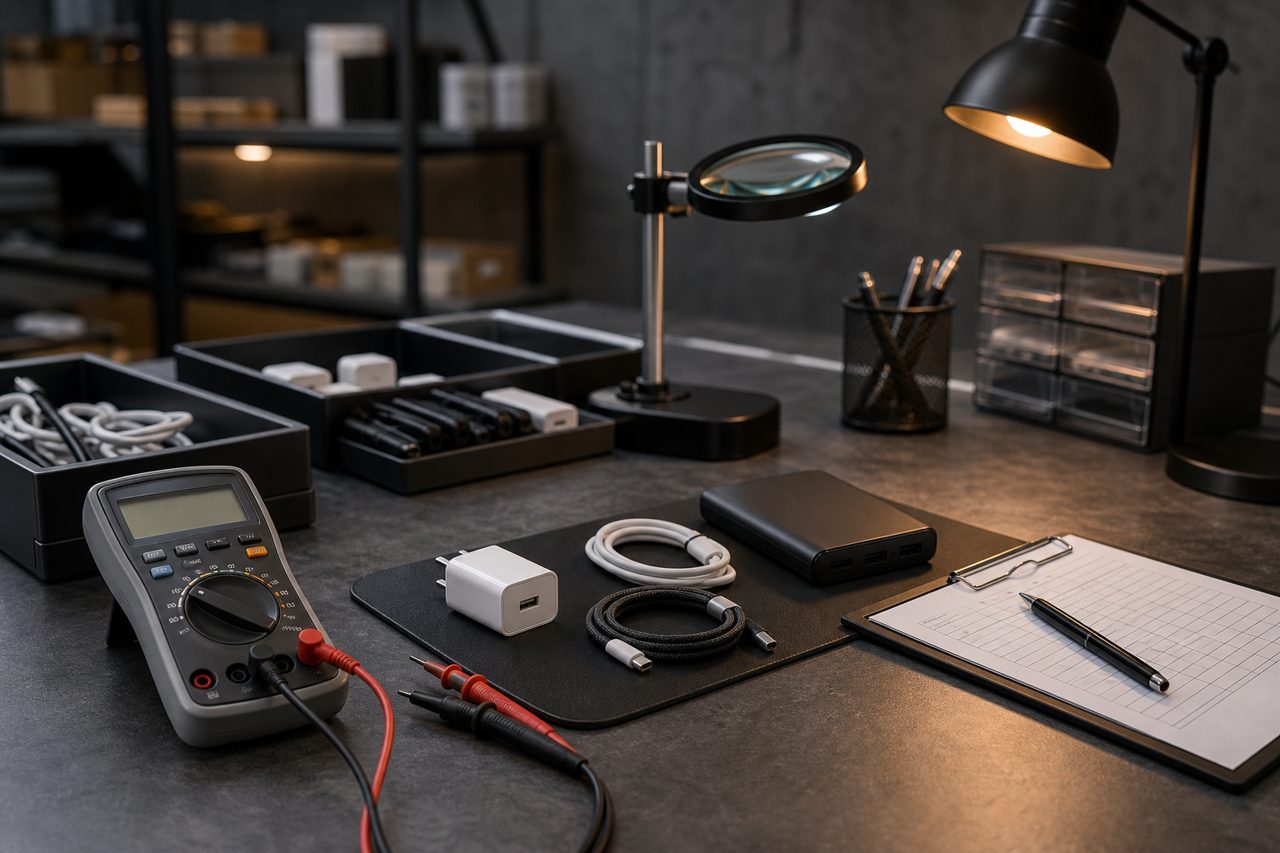
Whichever route you choose, verify the same core items:
- Entity and account match. Business license and export record, with the bank account name matching the legal entity.
- Category focus. Ask for the three SKUs they produce deepest, not the five thousand they list.
- Certificates per SKU, with numbers you can verify against the issuing databases.
- UN38.3 summary and shipping marks for any battery SKU, before quoting freight.
- A retail-style sample order, so you see exactly what a customer receives.
- Failure policy in writing: damage resend window, dead-on-arrival handling, and who pays return freight.
- Communication cadence: a named contact, working-hours overlap, and response measured in hours, not days.
- A trial order sized to hurt a little - enough units that quality issues surface, small enough to survive them.
Matching the route to your stage
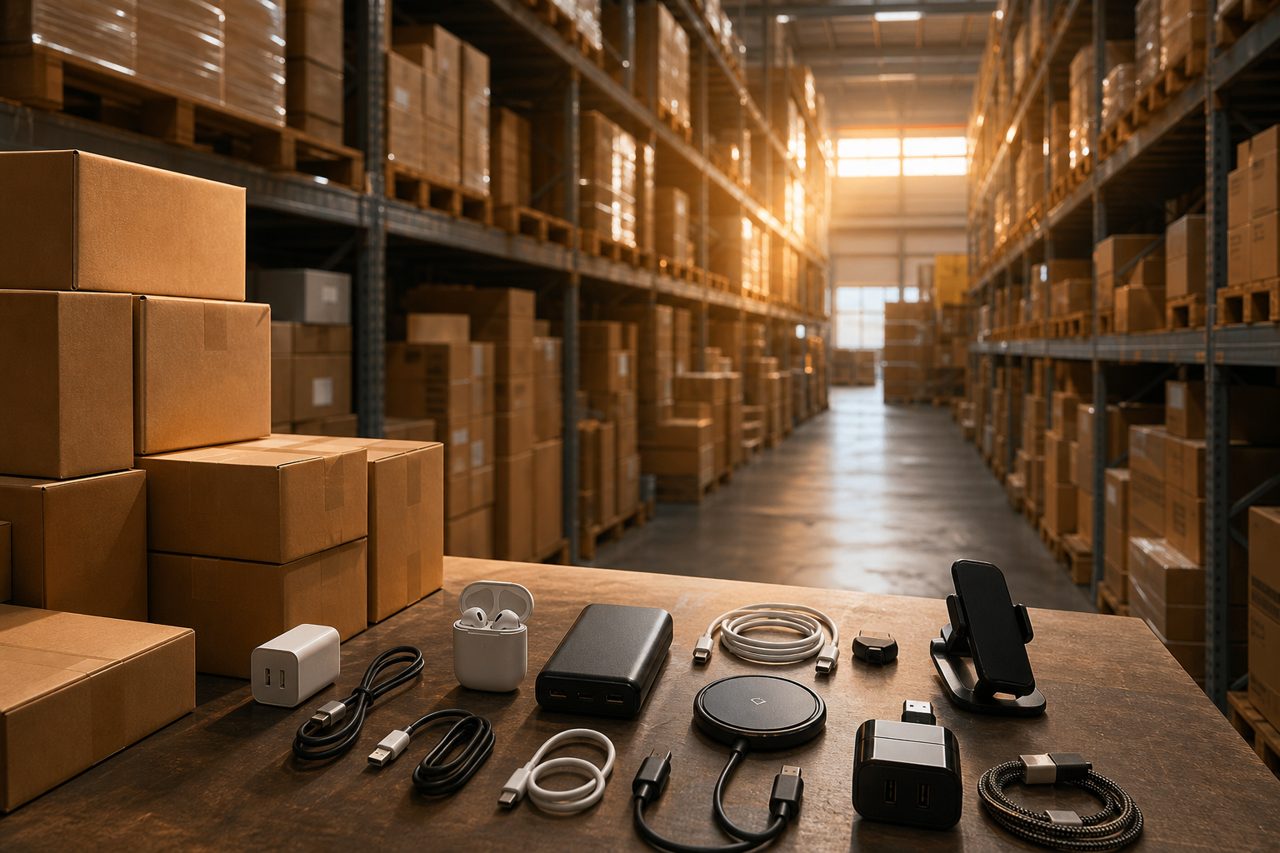
Stage one is validation: one-piece dropshipping from stock lets a listing test demand before inventory exists, with dispatch inside 48 hours on stock items. Stage two is light customization - logo printing and branded packaging from 500 units per SKU, sampling in 5-7 days - once a SKU proves it converts. Stage three is OEM from 1,000 units per SKU with 7-12 day sampling, for the products that anchor a brand.
The buyers who lose money in China are rarely cheated; they are early. They commit container-level capital to a SKU that has never survived contact with a listing. The landscape rewards the reverse order: test at one piece, customize at five hundred, tool at a thousand.
Whichever stage you occupy, ask the logistics question before the price question. Standard parcels ride the 7-15 day small-parcel lane; lithium-cell products travel the dedicated 8-18 day battery lane under the compliance rules above; and an overseas warehouse cuts the last mile to 2-5 days for proven SKUs. A quoted unit price means little until the delivery promise it supports is one your listing can honestly make.
Sourcing note
The full six-category range - charging, cables and hubs, audio, phone and tablet accessories, wearables and creator gear - is listed on the products page. Stock items ship one-piece through dropshipping with 48-hour dispatch; the light-customization and OEM tiers, including sampling lead times, are detailed on the OEM/ODM page.
FAQ
Do I still need to visit factories in China before ordering?
Less than before, and for different reasons. Video audits, certificate numbers and trial orders answer most qualification questions remotely. A visit still pays when tooling is involved or volumes justify a dedicated line, but for most accessory catalogs those are the exceptions rather than the rule.
What is the single most common first-order mistake?
Committing inventory before a SKU has proven conversion. Stock-level dropshipping exists precisely to remove that risk: let listings generate the evidence first, then buy depth for the winners. Buyers who lose money in China are rarely cheated; they are early.
Which compliance documents matter most for 3C accessories in 2026?
Per market: CE documentation including the USB-C requirements for EU-bound charging products, FCC authorization for anything with Bluetooth or Wi-Fi entering the US, and UN38.3 test summaries with the correct IATA packaging instructions for every lithium-cell SKU. Ask for these before the first order, not after the first customs hold.