Verifying Battery Claims on Earbuds: A 3-Step Bench Test
Battery life is the most quoted number in the earbud category - and the least audited. Vendors quote hours under unstated conditions, listings copy the spec sheet, and buyers discover the gap in reviews. This bench test verifies a claim in three steps with inexpensive equipment, so you stock products whose numbers you can prove.
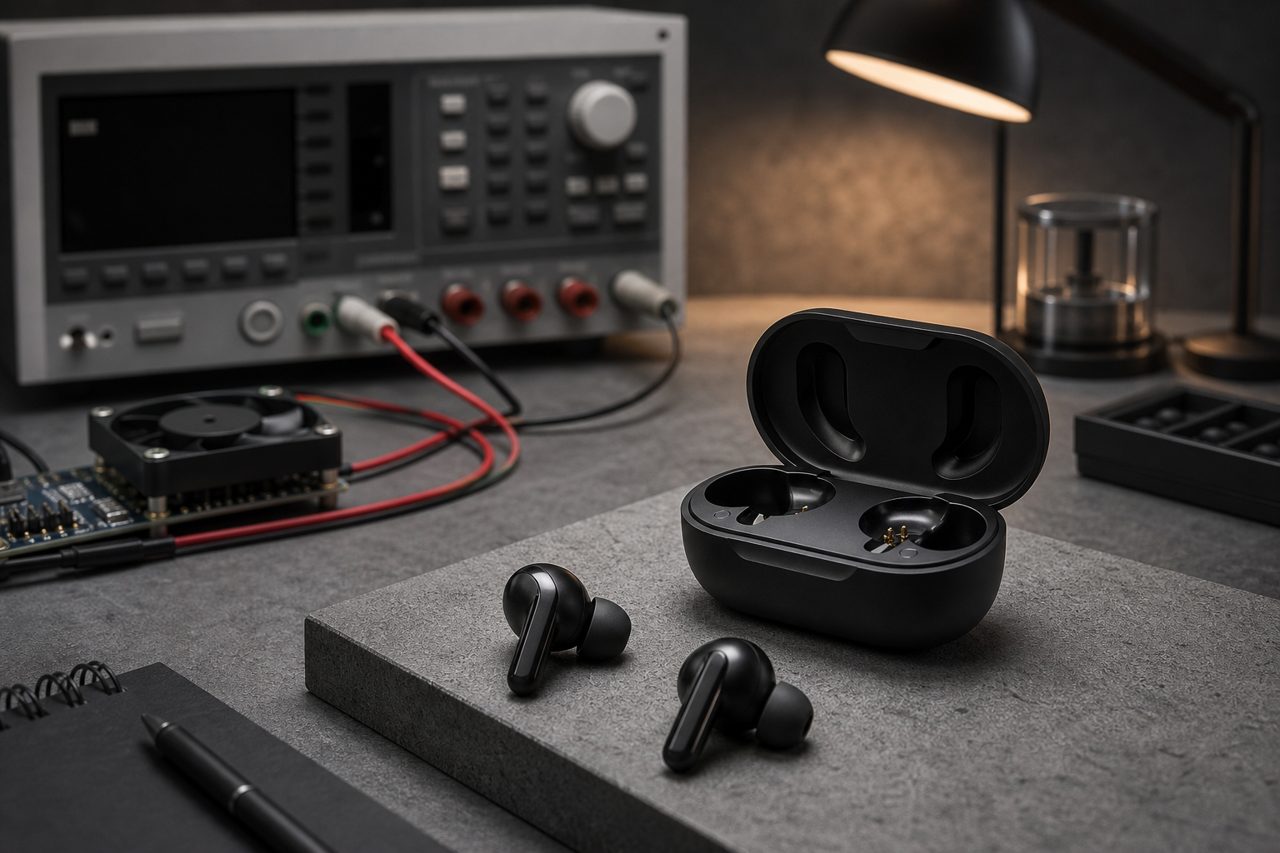
The test exists because "hours" is undefined until you define it. Playback time depends on volume, active noise cancellation, codec traffic and where the measurement stops - at the first low-battery warning or at shutdown. The claim itself may be bud-only, or a total that adds case recharges. None of this makes the claim dishonest; it makes it unverified. The three steps below measure charge input, bud runtime and case recharge count, and the output is a number you can print with a method statement behind it.
Where battery claims drift
Four patterns account for most gaps between spec sheet and shelf. First, condition mismatch: claims measured at low volume with cancellation off do not survive buyers who use both. Second, definition mismatch: a "total playtime" that multiplies bud hours by case recharges is technically legal and practically useless if the bud-only figure is never stated. Third, sample drift: cell sourcing changes across production batches, and a claim verified on pre-production samples may not hold on the container you receive. Fourth, rounding drift: small overstatements at each stage compound into a headline number no single component supports. A bench test closes all four with the same procedure.
The bench kit
Everything fits in a drawer:
- A USB power meter that reads voltage, current and accumulated milliamp-hours, placed inline on the charging cable.
- A timer - a phone works - and a ledger (notebook or spreadsheet) with one row per event.
- One fixed test track or playlist and the same phone for every run, so volume and codec behavior stay constant.
- The product's spec sheet with the three claims written down before you start: bud-only hours, total hours with the case, and charge time.
- A second identical unit if you have one, so two runs proceed in parallel.
Step 1: Verify charge input and charge time
With the case and buds fully depleted, charge through the meter and log two figures: total milliamp-hours delivered and wall-clock time to full. Compare the time against the claimed charge time; a large gap means the spec was optimistic or the unit under test is not the spec's unit. The milliamp-hour reading is an input figure at 5 volts, not the cell's rated capacity, because charging circuits lose energy as heat - but it sets a ceiling. A case whose claimed capacity could not plausibly fit under the measured input, even generously, has told you something before Step 2 begins.
Step 2: Continuous playback to depletion
Charge the buds fully, disconnect the case, and play the fixed track at half volume - cancellation on, if the product features it. Start the timer and let it run to shutdown, recording the exact figure, and note which endpoint you used: shutdown or the first low-battery warning. Either is defensible as long as the listing uses the same one. Rerun with cancellation off if the feature exists, because buyers will quote both. Repeat the full cycle three times and take the median; single runs carry startup variance. If the buds report battery level separately and one side consistently dies well before the other, log that too - uneven cell matching between left and right is a real factory defect and a specific complaint shape in reviews. The point of disconnecting the case is isolation: this number is the honest bud-only figure, the one most listings never state and the one every other claim multiplies from.
Step 3: Count case recharges
With the buds depleted, seat them in the case and let it recharge them to full, then run playback again. Repeat - charge, play, measure - until the case itself is empty, logging each cycle. Multiply the Step 2 median by the number of completed recharges plus one: that is the defensible total playtime figure. Two failure modes show up here that spec sheets never mention: a case that delivers fewer recharges than claimed (a capacity or cell problem) and a case whose later cycles cut off early (protection-circuit behavior). Both are container-level problems invisible in any single charge.
The verdict table
Score the unit against the claims you wrote down before starting. The tolerances are house rules - set them before testing so the verdict is not negotiated afterward:
| Item | Method | What to record | Suggested pass line |
|---|---|---|---|
| Charge time | Full charge through the meter | Minutes to full, mAh delivered | Within about 15% of claim |
| Bud playback | Median of three runs at half volume, ANC on | Hours to shutdown | At least 90% of claim |
| ANC-off playback | Same run with ANC off (if featured) | Hours | At least the ANC-on figure |
| Case recharges | Full case depletion, cycle by cycle | Count of complete recharges | Claimed total within about 10% |
A unit that misses one line by a little is a listing-copy problem; a unit that misses by a lot is a sourcing problem. Treat them differently.
Turn results into listing copy
The test's second output is a method statement: "measured at 50% volume with ANC on, shutdown endpoint, median of three runs." Print the measured median rather than the vendor claim wherever the two differ, because the median is the number your reviews will converge on. State the bud-only figure and the total-with-case figure as two separate lines instead of one blended headline; a buyer who can reconstruct your arithmetic rarely disputes it. If the measured charge time came in above the claim, print the measured one - charging speed is checked within the first week of ownership, long before battery endurance, so it is the first claim your reviews will grade. Products that clear the table let you publish exact figures; products that do not go back with the ledger attached - a faster conversation with a supplier than a star-rating curve six months later.
From bench to order
Run this on real units before committing capital. Through the dropshipping program, samples ship one piece at a time with 48-hour dispatch, so a two-unit bench can be running within a week of first contact. Re-run a shortened version - Step 2 only, one cycle - on each new production batch, because cell sourcing changes across runs and the claim you verified applies to the batch you tested. If the hardware is right but the copy is wrong, packaging claims are reviewed at the 500-piece light-customization tier; if the cells themselves are the problem, changing them is an engineering decision - OEM customization starts at 1,000 pieces per SKU with sampling in 7-12 days. The audio category lists in-stock models with their stated battery claims, ready for the bench.
FAQ
How long does the full test take?
Two to three days of wall-clock time, most of it passive charging and playback; active bench work is a few hours. Two units tested in parallel roughly halve the calendar.
Should I test with ANC on or off?
On - that is how owners use the product, so the on-figure is the honest one to advertise. Rerun with it off for a second spec line if you want both.
What if the measured figure is lower than the claim?
Within your pass tolerance, adjust the listing copy and move on. Far below it, return the units with the ledger and either renegotiate the claim or the product; do not stock a number your own bench already disproved.