FBA Prep for 3C Accessories: Labeling, Packing, Batteries
Marketplace fulfillment is unforgiving to sloppy preparation. A shipment that arrives mislabeled or under-documented does not merely delay; it sits in receiving limbo while your launch calendar burns. For 3C accessories, almost every prep failure lands in one of three buckets: labeling, packing or batteries. This article turns each into a checklist.

The commercial backdrop keeps raising the stakes. Online channels captured 35.5% of U.S. mobile accessories sales in 2023 and the share keeps rising (Grand View Research), while the U.S. mobile accessories market itself was worth USD 21.66 billion in 2023, heading to USD 34.22 billion by 2030 (Grand View Research). Plenty of competition is preparing correctly. A prep failure is not just an operational cost; it is share handed to a rival.
Labeling: The Unit-Level Checklist
Marketplaces track inventory two ways: the manufacturer's barcode or a fulfillment-center-specific unit identifier such as the FNSKU. Your first decision per SKU is which tracking method applies, and it must be decided before goods are packed, not when the truck arrives:
- Confirm the tracking method per SKU in your seller account before production ends.
- Cover, never overwrite. Where a unit label is required, it must fully cover any existing barcode so scanners cannot read two codes.
- Flat surfaces only. A label across a curved cable spool or a rounded case edge will not scan reliably; place it on the flattest panel of the package.
- Keep regulatory marks visible. Do not place unit labels over CE marks, warnings or rating information; those must remain readable on the shelf.
- Print quality matters. Use a thermal printer at adequate resolution; inkjet smudge and faded toner are classic refusal causes.
- Carton-level labels are separate. Shipment labels go on the outside of each box, clear of seams and edges.
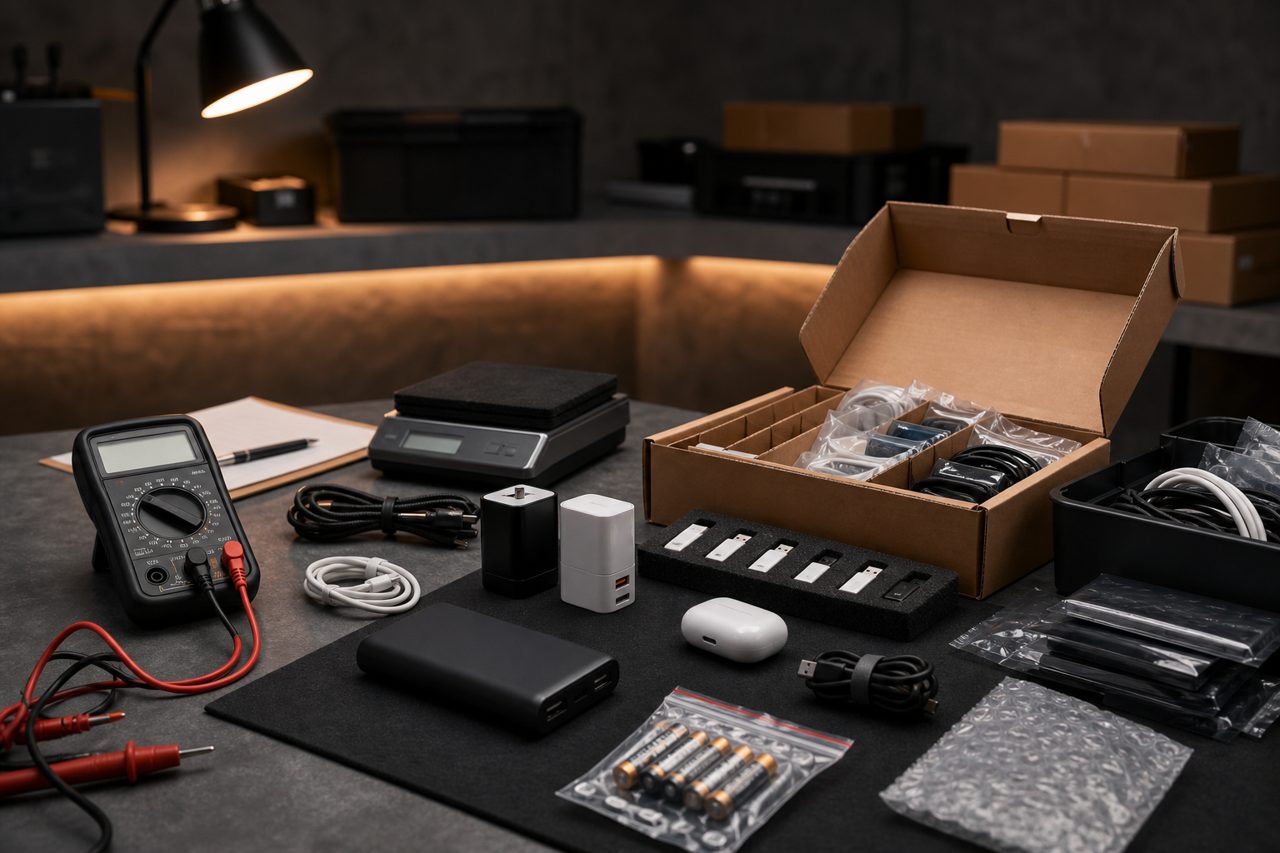
Packing: The Carton-Level Checklist
Packing failures are quieter than labeling failures. Nothing is refused outright; instead, units arrive damaged, loose or bagged wrongly, and the cost leaks out as unsellable inventory:
- Poly-bag anything with small parts. Cases, cables and adapters with loose accessories go in sealed poly bags; marketplaces require a suffocation warning on bags with a certain opening size, and transparent bags let receiving staff see the contents.
- Bag fit matters. A bag that is tight against sharp edges splits; a bag five sizes too big reads as loose packaging.
- Respect the per-carton weight ceiling. The commonly enforced ceiling for marketplace shipments is 22.5 kg (50 lb) per carton; heavier boxes require special handling and slow receiving.
- Dunnage between tiers. Boxed units stacked directly on each other abrade; a flat layer of dunnage between rows prevents scuffed retail windows.
- Build cartons to survive the journey, not the pallet. International legs stack, shift and drop; six-box-high plans on soft corrugate fail in transit, not on the drawing.
- Mark boxes as needed. Battery-handling labels where the packing instruction requires them, plus any required country-of-origin marking on the carton.
Batteries: The Documentation Gate
Battery rules are where 3C shipments most often stall, and where the checklist is least forgiving:
- UN38.3 test summary must exist for every battery model in the shipment, and it must match the cells actually installed.
- Know your packing instruction. Equipment with built-in, non-removable batteries typically moves under PI967 in the IATA framework; batteries packed with equipment fall under PI966. Each carries its own marking, labeling and quantity limits per package.
- Declare honestly at listing. Marketplaces ask for battery chemistry, cell count and watt-hour ratings as listing attributes; guesswork here surfaces later as listing takedowns.
- Expect extra checks in peak season. Carriers tighten battery acceptance when capacity is scarce; shipments without complete paperwork are the first to be bumped.
This is deliberately a supplier-side problem. TECHORIGIN ships battery-built products on UN38.3-compliant lanes aligned with PI967, with 48-hour dispatch on in-stock items, and covers transit damage with photo-based reshipment within 30 days of delivery. The battery file follows the goods from our bench to your receiving door.

Pre-Shipment Parameter Table
| Item | What to verify | Common mistake |
|---|---|---|
| Tracking method | Manufacturer barcode or FNSKU chosen per SKU in the account | Deciding after goods are packed |
| Unit label | Covers old barcode, flat surface, regulatory marks visible | Label wrapped around a curve |
| Poly bag | Sealed, suffocation warning where required, contents visible | Loose accessories rattling in master cartons |
| Carton weight | At or under 22.5 kg (50 lb) | Dense loads of chargers blowing past the ceiling |
| Battery file | UN38.3 summary matches installed cells; correct PI chosen | Report for a similar cell, not the shipped one |
| Carton labels | Shipment label flat, clear of seams; handling labels as required | Label placed across the box seam |
Who Should Do the Prep
For most importers the answer is the supplier, for three reasons. The bench where units are packed is the cheapest place on earth to apply a label correctly. Cartons built around the product protect better than cartons repacked at destination. And errors caught in Shenzhen cost minutes, while the same errors caught in a marketplace warehouse cost inbound delays and re-work fees. Supplier-side prep is also where customization pays off: packaging changes, logo printing and insert cards are part of the light-customization tier at TECHORIGIN, starting at 500 pieces per SKU, while full OEM packaging work starts at 1,000 pieces per SKU under the OEM/ODM program.
Keep prep in-house only when you consolidate goods from several suppliers into one inbound, or when local regulation requires final assembly or inspection on your side.
The Night-Before-Truck Audit
- Scan three random unit labels per SKU with a phone scanner; if they hesitate, reprint the batch.
- Weigh two random cartons; confirm they are under the ceiling.
- Open one carton per SKU and confirm bags, dunnage and units match the packing plan.
- Check that battery shipments carry their UN38.3 summary and the labels their packing instruction requires.
- Photograph each pallet before handover; the photos settle disputes later.
Prep discipline is invisible when it works and expensive when it fails. Products to apply it to are all around the six categories we supply, and for sellers still validating SKUs before committing to bulk inbound, one-piece dropshipping is the low-risk on-ramp.
FAQ
Do I need unit labels if the manufacturer barcode is already printed on the box?
Only if you have chosen the manufacturer-barcode tracking method for that SKU. If your account uses the FNSKU method, or if the same listing is shared by multiple sellers, every unit needs an FNSKU label that fully covers the original barcode. Deciding this per SKU before production avoids the worst case: thousands of units arriving with a barcode problem that only manual re-labeling can fix.
Can battery products such as power banks and TWS earbuds enter fulfillment centers?
Yes, with documentation. Batteries must be UN38.3 tested, built-in battery equipment moves under packing instruction PI967 in the IATA framework, and marketplaces additionally ask for battery details such as cell chemistry and watt-hour ratings at listing time. The reliable path is a supplier whose battery lane already runs compliant, so the paperwork travels with the goods instead of chasing them.
Should prep happen at my end or at the supplier's?
Supplier-side prep is usually cheaper and more consistent: labels go on at the bench where units are packed anyway, cartons are built around the product instead of repacked, and errors are caught before the international leg rather than after it. Keep prep at your own warehouse only when you need to combine goods from several suppliers into one shipment or when local regulations require it.